Cloaking
Cloaking means showing search engine crawlers different content than users, most often to manipulate rankings. Google defines it as presenting different content to users and search engines with the intent to manipulate search rankings and mislead users. Cloaking violates Google's spam policies and the Bing Webmaster Guidelines. A site that uses it may drop in the results or be removed from them entirely.
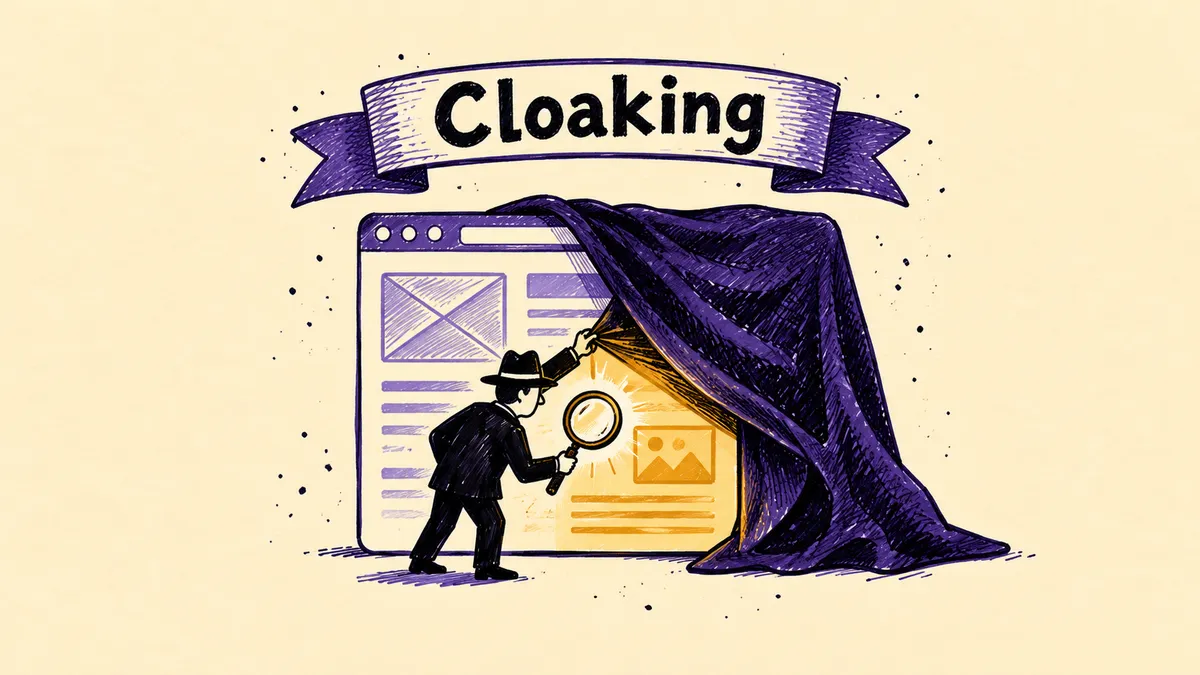
The name comes from the English word cloak, a garment that covers and conceals. The crawler sees a page prepared for ranking, while a person sees content hidden under that “cloak”.
How does cloaking work?
Cloaking works by having the server recognize who sends the request and return a different version of the page accordingly. The search engine crawler gets keyword-stuffed content, while the user gets something completely different. Recognition is most often done in several ways.
| Technique | How it works |
|---|---|
| User-agent cloaking | The server checks the browser header and handles the crawler differently |
| IP-based cloaking | The server recognizes an IP address belonging to a search crawler |
| JavaScript cloaking | After the script runs, the user sees different content than the crawler |
| Hidden text for the crawler | Extra keywords are added to the page only for the search engine |
| Sneaky redirect | The crawler sees the page, while the user is sent to a different URL |
Examples from Google's guidelines
Google gives two typical examples of cloaking. The first is a page about travel destinations shown to search engines while users see a page about discount drugs. The second is inserting text or keywords only when the page is requested by a crawler. Google also describes a related technique: sneaky redirects. An example is a normal page for desktop users and a redirect of mobile users to a completely different spam domain.
How do search engines treat cloaking?
Search engines treat cloaking as spam, because it breaks the match between a search result and what the user sees after clicking. Google's spam policies describe practices that can lower a site's rankings or remove it from the results entirely. Cloaking is one of them. Google informs site owners about manual actions in Google Search Console.
Bing takes a similar position. The Bing Webmaster Guidelines call showing crawlers different content than users a manipulative practice. According to Bing, it undermines a site's trust and visibility. Bing notes that sites should not serve materially different experiences to crawlers and visitors.
Cloaking after a site is hacked
Cloaking is not always the site owner's decision. Google notes that hackers often use it to make an attack harder to detect. The owner sees a normal page in the browser, while the crawler indexes injected links or spam content. Another abuse of someone else's domain is parasite SEO.
What is not cloaking?
Varying content is not cloaking when it does not mislead and gives the crawler the same as the user. What matters is intent and content consistency, not the mere fact that page versions differ. Google points to several borderline situations.
| Situation | Google's position |
|---|---|
| Paywall or content behind registration | Not cloaking if Google sees the full content like a user with access and the site follows the Flexible Sampling guidelines |
| Dynamic rendering | Usually not cloaking if the crawler and the user get similar content |
| Dynamic rendering with different content | Can be cloaking, e.g. a page about cats for users and about dogs for crawlers |
| Redirect after a URL change | Has many legitimate uses and is not spam |
Dynamic rendering
Dynamic rendering means serving crawlers a pre-rendered version of a JavaScript-based page. Google describes it as a workaround, not a recommended solution, because it adds complexity and costs. As long as both versions have similar content, Googlebot does not treat it as cloaking. For content that is hard for crawlers to access, e.g. JavaScript or images, Google points to its own recommendations instead of hiding content.
Frequently asked questions
Q.What are the consequences of cloaking?
The main consequence of cloaking is a drop in a site's rankings or its removal from search results. Google considers cloaking a violation of its spam policies. Bing calls it a manipulative practice that undermines a site's trust and visibility. In practice this means losing organic traffic, and rebuilding visibility requires removing the problem.
Q.Is a paywall cloaking?
No, if Google sees the full content behind the paywall the same way as a user with access. Another condition is following the Flexible Sampling guidelines described by Google. The crawler then indexes the content a subscriber will actually see. Cloaking would mean showing the crawler content that no user gets.
Q.How can cloaking appear on a site that does not use it?
A common cause is a hacked site. Google notes that hackers often use cloaking so that the owner does not notice the attack. The site then looks normal in the browser, while the crawler sees injected spam.
Q.Is dynamic rendering cloaking?
Usually not, if the crawler and the user get similar content. That is what the Google Search Central documentation indicates. Dynamic rendering becomes cloaking when the two versions differ in topic. Google considers it a workaround, not a recommended solution, because it increases the complexity and cost of maintaining a site.
Let's talk growth
Send a brief or drop your contact. We'll reply within 24h.
Get a quote