Google Ads
Google Ads is Google's online advertising system in which advertisers buy ad impressions in Search, on YouTube, in Gmail, Maps and on partner sites. Until July 2018 it operated under the name Google AdWords. Ads are shown based on an auction in which not only the bid counts, but also the quality of the ad and the landing page. The advertiser most often pays per click (the CPC model), and also for impressions, views or conversions.
Google Ads should be distinguished from the AdSense program. Google Ads is used by advertisers to buy ads. AdSense lets publishers earn money by showing those ads on their own sites.
How was Google Ads created?
Google Ads grew out of the AdWords program, which launched on 23 October 2000. Search Engine Land reports that about 350 advertisers used it on launch day. AdWords was a self-serve system in which advertisers chose keywords themselves. Earlier, from August 2000, Google sold ads in the Premium Sponsorships program, billed per thousand impressions.
| Year | Event |
|---|---|
| 2000 | Launch of the AdWords program |
| 2012 | Product search switches to the paid Google Shopping model |
| 2013 | Enhanced Campaigns increase the importance of mobile ads |
| 2018 | AdWords is renamed Google Ads, and the interface moves to ads.google.com |
The name change took place on 24 July 2018. The new brand was meant to cover all ad formats, not only text ads in Search. In the following years Google relied more and more on automation. Examples are Performance Max campaigns and the AI Max feature suite for Search campaigns.
How does the Google Ads auction work?
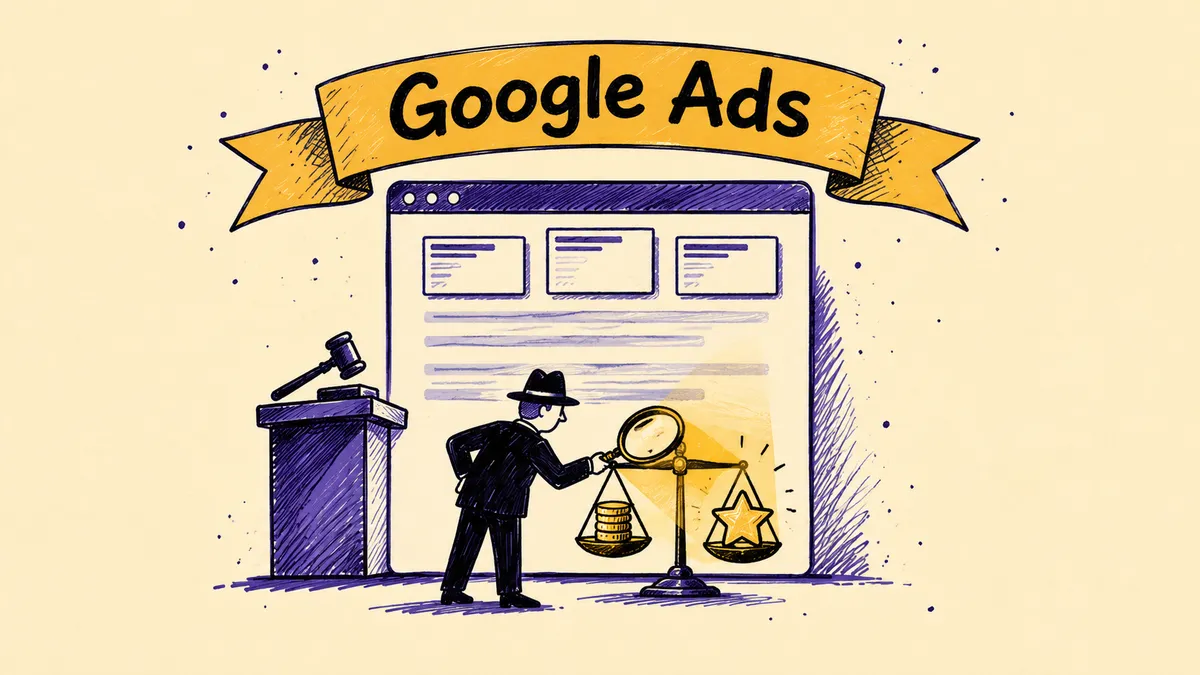
The Google Ads auction takes place for every search that can show ads. The system first checks which ads are eligible to show and then determines their order. This is decided by Ad Rank, recalculated in every auction and for every position on the results page.
According to Google Ads Help, Ad Rank depends on six factors:
- the advertiser's bid;
- the quality of the ad and the landing page;
- Ad Rank thresholds, i.e. the minimum quality required for a given position;
- the competitiveness of the auction;
- the context of the person's search;
- the expected impact of assets and other ad formats.
Because Ad Rank combines the bid with quality, an ad with a lower bid can take a higher position than the competition. Google also notes that the actual cost per click is often lower than the maximum bid set. Higher ad quality can lower the cost per click.
What is Quality Score?
Quality Score is a rating on a scale from 1 to 10, available for keywords in Search campaigns. It is made up of three components: expected click-through rate, ad relevance and landing page experience. Each of them is rated as above average, average or below average. Google stresses that Quality Score is not an input in the auction, but a diagnostic tool. It shows what to improve in ads, landing pages or keyword selection. The landing page is an area shared here by paid advertising and CRO.
What campaigns can you run in Google Ads?
The campaign type in Google Ads determines where the ad will show and what goal it will be optimized for. The choice depends on whether the advertiser wants to reach people who are actively searching, or to build demand and awareness.
| Campaign type | Where ads show | Typical goal |
|---|---|---|
| Search | Google search results | Sales, leads, website traffic |
| Performance Max | All of Google's ad inventory from one campaign | Conversions optimized by Google AI |
| Shopping | Search results and the Shopping tab | E-commerce sales |
| Display | Websites, apps and Google properties, e.g. YouTube | Reach, awareness, sales |
| Video | YouTube and other sites | Conversions, reach, views |
| Demand Gen | YouTube including Shorts, Discover, Gmail, Maps, the Display Network | Building demand and engagement |
| App | Search, Google Play, YouTube, Discover | Installs and in-app activity |
Shopping campaigns and Performance Max for stores use the product feed from Google Merchant Center. For Search campaigns Google also offers AI Max. It is a set of features that broaden query matching, adapt ad text and choose the landing page URL.
What bidding strategies are available?
The bidding strategy is chosen to match the campaign goal. Google groups them by what the advertiser cares about most.
| Goal | Strategies |
|---|---|
| Conversions | Target CPA, Maximize conversions |
| Conversion value | Target ROAS, Maximize conversion value |
| Clicks | Maximize clicks, Target CPC, Manual CPC bidding |
| Visibility | Target impression share, CPM, target CPM, vCPM |
| Video views | CPV, target CPV, CPM |
Strategies focused on conversions and their value are known as Smart Bidding. They set the bid automatically in every auction. However, they require correct conversion tracking, implemented e.g. through Google Tag Manager. Target ROAS is based on the ratio of conversion value to ad cost, so it is easy to link to an ROI assessment.
Frequently asked questions
Q.Does a higher bid guarantee the top ad position?
No, the bid alone does not guarantee the top position. Ad Rank also takes into account the quality of the ad and the landing page, Ad Rank thresholds, auction competitiveness and search context. An ad below the threshold for a given position cannot show in it. Improving quality can therefore be more effective than raising the bid.
Q.Does Quality Score directly affect the auction?
No, Quality Score is not an input in the auction. Google describes it as a diagnostic tool on a scale from 1 to 10 for keywords. Its three components, expected click-through rate, ad relevance and landing page experience, do however point to areas that affect ad quality in the auction.
Q.What is the difference between Google Ads and AdWords?
Google Ads is the new name of the AdWords program, introduced on 24 July 2018. The name change was meant to show that the system covers more than text ads in Search. It also includes display, video, shopping and app ads. The interface then moved from adwords.google.com to ads.google.com.
Q.Do Google Ads improve rankings in organic results?
No, Google Ads Help states that Google search results are independent of its advertising programs. Spending on Google Ads does not affect a site's ranking in free search results. The two can, however, complement each other. Query and conversion data from campaigns help, for example, choose topics for SEO.
Let's talk growth
Send a brief or drop your contact. We'll reply within 24h.
Get a quote