Google Panda algorithm
Google Panda was a Google Search system that lowered the rankings of low-quality sites and helped valuable, original content rank higher. Google announced it in February 2011, and the first version changed results for almost 12% of queries in the US. In August 2011 Panda was extended to most languages. The name comes from the surname of a Google engineer. According to Google, in 2015 Panda became part of the search engine's core ranking systems.
What was the Google Panda algorithm?
Google Panda was a ranking system designed to assess the quality of whole sites and reduce the visibility of pages with thin content. Google's guide to ranking systems describes it as a system meant to better ensure high-quality and original content in search results.
Its main target was so-called content farms: sites that mass-published short, shallow articles aimed at popular queries. Danny Sullivan of Search Engine Land called the update "Farmer" because it hit such sites.
| Feature | Description |
|---|---|
| Type | a site quality assessment system in Google Search |
| Announced | February 2011 |
| Name | from the surname of a Google engineer |
| Unofficial name | "Farmer", after content farms |
| Goal | lowering the rankings of low-quality content |
| Current status | part of the core ranking systems since 2015 |
Amit Singhal explained the name in an interview with Wired in March 2011. He said the team named the update internally after an engineer called Panda.
How did the Panda algorithm start and evolve?
Panda launched in 2011 and rolled out in stages: first in the US, then for all English-language users, and then for other languages. In 2015 it stopped being a separate system.
| Date | Change | Reach according to Google |
|---|---|---|
| February 2011 | first rollout in the US | almost 12% of US queries |
| 11 April 2011 | rollout to all English-language users | additional signals: about 2% of US queries |
| 12 August 2011 | rollout in other languages, including Polish | typically 6–9% of queries |
| 2015 | incorporated into the core ranking systems | no separate updates |
In April 2011 Google began, in some cases, to use data about sites that users had blocked. The August rollout excluded Chinese, Japanese and Korean, where Google was still testing the changes.
While building Panda, Google relied on external quality raters. According to Singhal, they were asked questions such as whether they would give this site their credit card details. Singhal also said that sites demoted by Panda overlapped 84% with sites users had blocked in the Chrome browser.
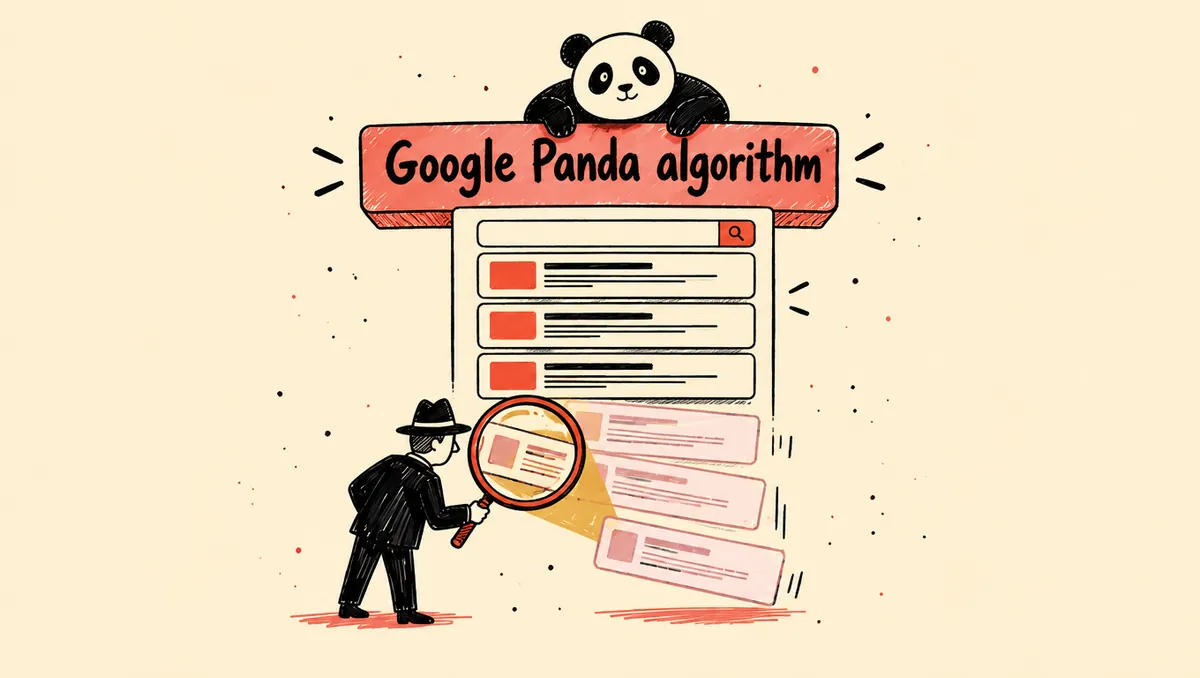
Which sites did Panda rate poorly?
Panda rated poorly sites with thin, duplicated or carelessly produced content. Google did not disclose its ranking signals, but in May 2011 it published a list of 23 questions describing how the company thinks about page quality.
| Area | Example questions from Google, 2011 |
|---|---|
| Trust | Would you trust the information in this article? Would you give this site your credit card details? |
| Expertise | Was the article written by an expert or enthusiast, or is it shallow? |
| Duplication | Does the site have duplicate or very similar articles on the same topic with slightly different keywords? |
| Originality | Does the article provide original information, research or analysis? |
| Care | Does the text have spelling, stylistic or factual errors? |
| Ads | Are there so many ads that they distract from or obscure the content? |
| Completeness | Does the article cover the topic fully, or is it short and lacking specifics? |
A key feature of Panda was that it assessed the whole site. Google said that low-quality content on part of a site could lower the rankings of the entire site. It therefore recommended removing weak pages, merging thin texts into more useful ones or moving them to a different domain.
Google also stressed that Panda was just one of roughly 500 search changes planned for 2011. Some site owners wrongly blamed it for ranking drops caused by other changes.
What does Panda mean today?
Panda no longer runs as a separate algorithm, but its principles are still part of Search. According to Google, the system evolved and in 2015 became part of the core ranking systems.
Google lists Panda in its guide to ranking systems among retired systems. That does not mean quality assessment has disappeared: Google's core ranking systems took over its functions.
In SEO practice, Panda changed how people approach content. It showed that a large number of short texts targeting keywords can hurt an entire site. The 2011 questions about trust, expertise and originality remain a useful reference when assessing page quality.
Frequently asked questions
Q.Where does the name Panda come from?
The name comes from the surname of one of Google's engineers. Amit Singhal explained this in an interview with Wired in March 2011. Before the official name was known, the SEO industry called the update "Farmer". Danny Sullivan of Search Engine Land was among those who used that name, because the update hit content farms.
Q.When did Panda reach languages other than English?
On 12 August 2011 Google announced the rollout in all languages except Chinese, Japanese and Korean, which also brought Panda to Polish search results. In most languages the change typically affected 6–9% of queries. The first US rollout in February 2011 affected almost 12% of queries.
Q.Is the Panda algorithm still active?
Panda no longer runs as a separate algorithm with its own updates. According to Google, the system evolved and in 2015 became part of the core ranking systems. Google now lists it among retired systems. Assessing content quality and originality is still part of how Search works, though.
Q.How did Panda assess page quality?
Google did not disclose the signals Panda used. In May 2011, however, it published 23 questions describing its approach to quality. They covered trust, author expertise, content originality, the number of ads and duplicate articles, among other things. Weak content on part of a site could lower the rankings of the whole site.
Let's talk growth
Send a brief or drop your contact. We'll reply within 24h.
Get a quote