Index bloat
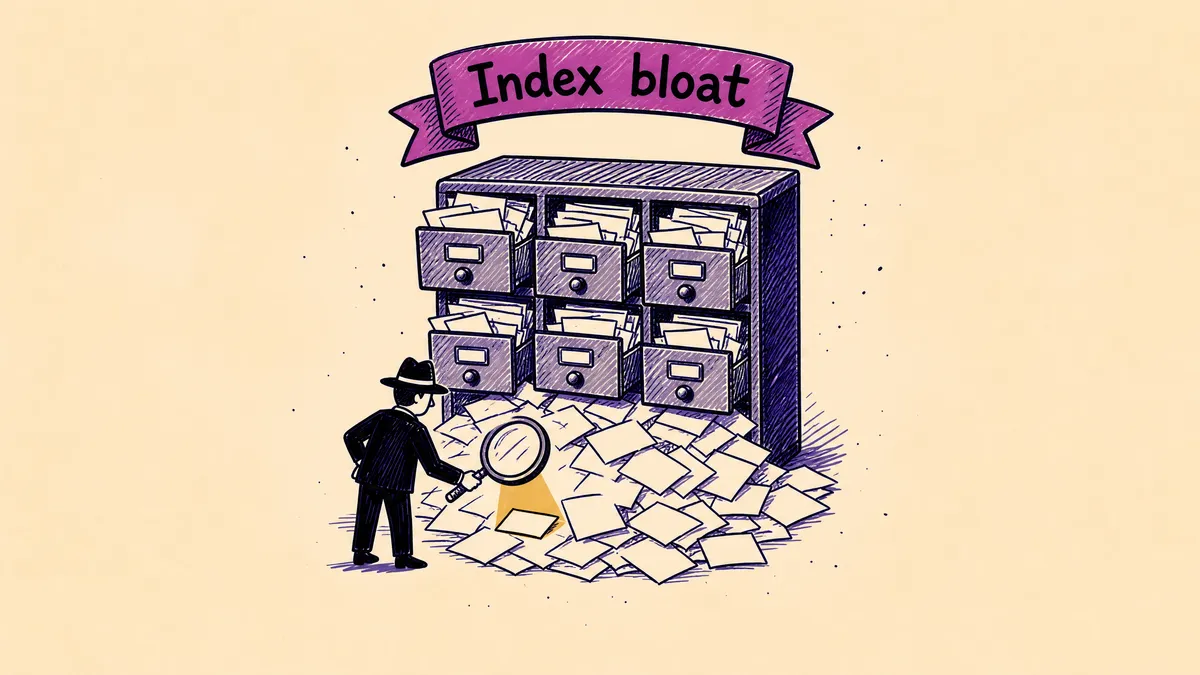
Index bloat is an excess of low-value pages from a website in a search engine's index. It refers to URLs that do not answer any user question: duplicates, filter pages, internal search results or empty archives. The problem is not the number of indexed pages itself, but their quality. Index bloat most often affects large online stores, portals and sites built on systems that generate URLs automatically.
In practice, index bloat shows up as a mismatch in numbers. The search engine has clearly more URLs in its index than the site has pages meant to appear in the results.
What causes index bloat?
Index bloat is caused mainly by URLs generated automatically by the site's system, not by content written by hand. A single product or article can be available at several URLs. A search engine may treat each of them as a separate page.
| Source of unnecessary URLs | Example |
|---|---|
| Faceted navigation and filters | Combinations of color, size and price parameters in a store category |
| URL parameters | Session IDs, UTM parameters, sorting variants |
| Internal search results | URLs such as /?s=phrase accessible to crawlers |
| Tags and archives | Tag pages duplicating categories, date and author archives |
| Default CMS settings | The same product under the URLs of several collections, print versions |
| Mass-generated content | Programmatic SEO pages created without quality control |
| Thin content | Product pages without a unique description, short posts with no value |
Why is faceted navigation a special case?
Faceted navigation creates a practically unlimited number of URLs. Google's documentation describes it as a source of “infinite URL spaces”. Every combination of filters produces a new URL, and the crawler does not know whether it is useful until it visits it. The result is overcrawling and slower discovery of new, valuable pages.
How does index bloat affect SEO?
Index bloat does harm on two levels: it wastes crawler resources and lowers the perceived quality of the whole site. The first problem mainly concerns large sites, the second can affect sites of any size.
Crawl budget
Google defines crawl budget as a combination of the server's crawl capacity limit and crawl demand. According to Google's documentation, the budget is affected by, among other things, the perceived number of URLs, including duplicates. A crawler that visits thousands of filter variants returns less often to important pages. Google indicates that crawl budget mainly concerns sites with more than 1 million unique pages or more than 10,000 pages that change daily. Another warning sign is a large number of URLs with the status “Discovered – currently not indexed”.
Site quality
A broad index of weak pages can lower the assessment of the whole site. Amit Singhal of Google wrote in May 2011 that “low-quality content on some parts of a website can impact the whole site's rankings”. It was a comment on the update known as the Google Panda algorithm. Google then recommended removing weak pages, merging them, expanding them or moving them. An additional effect is cannibalization: several similar URLs compete for the same keyword and none of them ranks high.
How to detect and remove index bloat?
Index bloat is detected by comparing the number of indexed URLs with the number of pages that are meant to be visible in the results. The basic tool is the “Pages” report in Google Search Console. The reference point is the XML sitemap, which should contain only URLs meant for indexing. A large surplus of indexed URLs over the sitemap shows which types of pages need to be reviewed.
What methods are used to remove unnecessary URLs?
The choice of method depends on whether the page should stay for users or disappear completely.
| Method | When to use | Limitation according to Google |
|---|---|---|
| Noindex | A page users need, but not in the results, e.g. internal search | The crawler still visits the page, so it does not save crawl budget |
| Rel="canonical" | Duplicates and variants, e.g. sorting or filters | For faceted navigation, less effective in the long run than robots.txt |
| Robots.txt | Whole groups of URLs by pattern, e.g. filter parameters | A blocked URL can still appear in the results, e.g. when links point to it |
| 404 or 410 status code | Pages removed permanently | A strong signal for the crawler not to return to this URL |
| 301 redirect or merging | Weak pages on the same topic | Requires moving valuable content to the target page |
What mistakes should you avoid when removing index bloat?
The most common mistake is combining noindex with a block in robots.txt. Google states that a page with noindex must not be blocked in robots.txt. A crawler that does not visit it will not see the noindex directive, and the URL may stay in the index. So first let the crawler read the noindex, and add the block only after the URLs have been removed from the index.
The second mistake is removing pages without analyzing traffic and links. A page with few visits may have external links or answer niche queries. It is safer to merge or redirect it than to delete it. For duplicates, content deduplication before deciding on removal helps.
Frequently asked questions
Q.Is a large number of indexed pages always index bloat?
No, a large number of indexed pages is not a problem in itself. Index bloat means an excess of low-value URLs, such as duplicates, filters or empty archives. A store with 50,000 unique product pages can have a healthy index. A site with 200 articles and 5,000 tag URLs cannot.
Q.Does noindex save crawl budget?
No, noindex does not save crawl budget. Google explains that the crawler still fetches a page with noindex and only then drops it. Noindex is used to remove a URL from search results. If the goal is to limit crawling of a group of URLs, Google recommends a block in robots.txt or a 404 or 410 status code.
Q.Do small sites need to worry about index bloat?
Yes, but for a different reason than large sites. Crawl budget matters mainly for sites with more than a million pages or rapidly changing content. A small site is more at risk of a lower quality assessment. Back in 2011, Google wrote that weak pages can affect the rankings of the whole site.
Q.How often should you check the index for index bloat?
Ideally after every major change to the site and periodically as part of an SEO audit. Changing the CMS, adding filters or a new category template can generate thousands of URLs in a short time. That is when it is worth comparing the “Pages” report in Search Console with the sitemap and checking new URL types.
Let's talk growth
Send a brief or drop your contact. We'll reply within 24h.
Get a quote