Performance Max
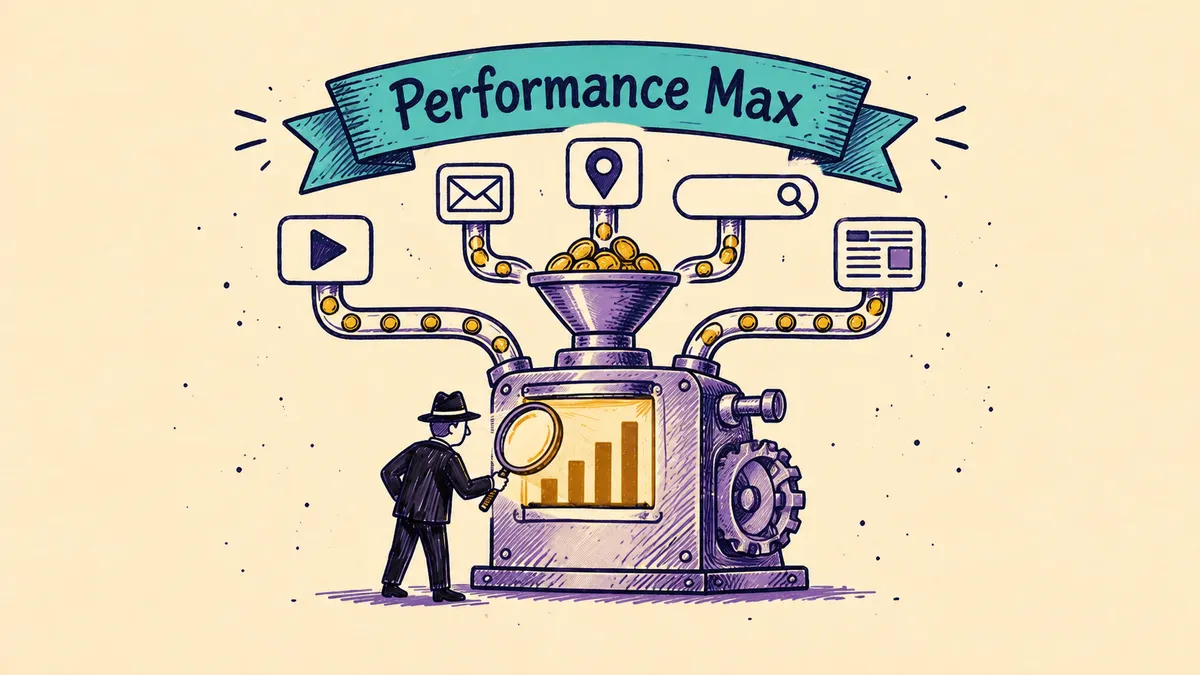
Performance Max (PMax) is a Google Ads campaign type that shows ads across all of Google's ad inventory from a single campaign. It covers YouTube, the Display Network, Search, Discover, Gmail and Maps. The campaign is goal-based: the advertiser defines conversions, and the system itself chooses channels, audiences, bids and creative combinations. Google made Performance Max available to all advertisers on 2 November 2021.
In practice, Performance Max replaced several earlier campaign types, including Smart Shopping campaigns and Local campaigns. Google describes it as a complement to keyword-based Search campaigns, not a replacement for them.
How does Performance Max work?
Performance Max works based on the conversion goal set by the advertiser. The system uses Smart Bidding, i.e. automated bidding in every auction based on the likelihood of a conversion. The advertiser can add a target CPA or a target ROAS. The budget goes where the system predicts the best results, regardless of the channel.
| Campaign element | Role |
|---|---|
| Conversion goal | Defines what the system should optimize: sales, leads or conversion value |
| Asset group | A set of headlines, descriptions, images and videos from which the system builds ads |
| Audience signals | Hints about the customer that speed up the campaign's learning |
| Search themes | Topics that help the campaign match queries; since August 2025 up to 50 per asset group |
| Product feed | Product data from Google Merchant Center for online stores |
| Final URL expansion | The option to send users to a page better matched to the query than the one specified |
Google can also generate additional images and videos with generative AI. However, the advertiser remains responsible for the content of landing pages and dynamically created assets.
How does Performance Max work with Search campaigns?
Performance Max and a Search campaign can run in parallel. According to Google Ads Help, the Search campaign takes priority when the query matches a keyword in exact match. This lets the advertiser keep control over the most important keywords. Brand exclusions also help limit overlap between campaigns.
How has Performance Max changed?
Performance Max has evolved from a campaign with very limited insight into data into a campaign type with increasingly broad reports and controls. The beta launched in October 2020, and general availability came in November 2021. Google reported at the time that advertisers saw on average 13% more incremental conversions at a similar cost per conversion.
| Period | Change |
|---|---|
| October 2020 | Beta version |
| 2.11.2021 | Availability for all advertisers |
| 2022 | Smart Shopping and Local campaigns upgraded to Performance Max |
| 2025 | Campaign-level negative keywords, full asset reports, channel report beta |
| 7.08.2025 | Search terms report, negative keyword lists, device and age targeting |
| 2026 | Customer list exclusions, budget report, full audience reports, placement breakdown by network |
The most important change was the channel performance report, presented in beta at Google Marketing Live 2025. It shows how many results come from Search, YouTube, the Display Network and other channels. Before that, the split of the budget between channels was largely invisible to the advertiser. Negative keywords apply to Search and Google Shopping inventory.
In 2026 Google announced exclusion of the advertiser's own customer lists. This makes it possible to focus the budget on new customers instead of people who have already made a purchase. A new budget report forecasts spend until the end of the month.
When is Performance Max worth using?
Performance Max works well when the advertiser has a clearly defined conversion goal, e.g. online sales or lead generation. Google recommends it precisely in this situation. The campaign can be created with the goal Sales, Leads, Website traffic or Local store visits and promotions. It can also be created without selecting a goal.
What are the advantages and limitations of Performance Max?
The main advantage is access to all Google channels from one campaign and automatic budget shifting. The main limitation is less control than with separate campaigns for each channel.
| Advantages | Limitations |
|---|---|
| One campaign covers YouTube, the Display Network, Search, Discover, Gmail and Maps | Less manual control over where and to whom the ad is shown |
| Bids set automatically in every auction | The quality of results depends on correct conversion data |
| Reaching new audience groups | Automatically created assets and landing pages need to be checked |
| Data-driven attribution and performance reports | Google Ad Grants campaigns may not have access to all inventory |
The effectiveness of Performance Max depends above all on the quality of conversion data. The campaign optimizes what is measured. Incorrectly set up tags or goals can therefore send the budget to the wrong places. That is why in 2025 Google added goal diagnostics that detect missing or broken tags. Conversion tracking can be implemented, among other ways, through Google Tag Manager, and with a value-based goal it is worth comparing results with the expected ROI.
Frequently asked questions
Q.Does Performance Max replace Search campaigns?
No, Google describes Performance Max as a complement to keyword-based Search campaigns. When a query matches a keyword in exact match, the Search campaign takes priority. Both campaigns can therefore run in parallel, and the most important keywords stay under the advertiser's manual control.
Q.Can you add negative keywords in Performance Max?
Yes, since 2025 campaign-level negative keywords are available in all Performance Max campaigns. They apply to Search and Google Shopping inventory. Since August 2025 you can also use negative keyword lists for many campaigns at once.
Q.Can you see in Performance Max which channel delivers results?
Yes, partly. In 2025 Google introduced a channel performance report in beta and a search terms report. Full asset statistics are also available. In 2026 audience reports and a placement breakdown by network were added, although some features are being rolled out gradually.
Q.How does Performance Max differ from Smart Shopping campaigns?
Performance Max covers all Google channels, while Smart Shopping was a shopping campaign with a narrower reach. In 2022 Smart Shopping and Local campaigns were moved to Performance Max. Online stores use the product feed from Google Merchant Center in it.
Let's talk growth
Send a brief or drop your contact. We'll reply within 24h.
Get a quote