Remarketing (retargeting)
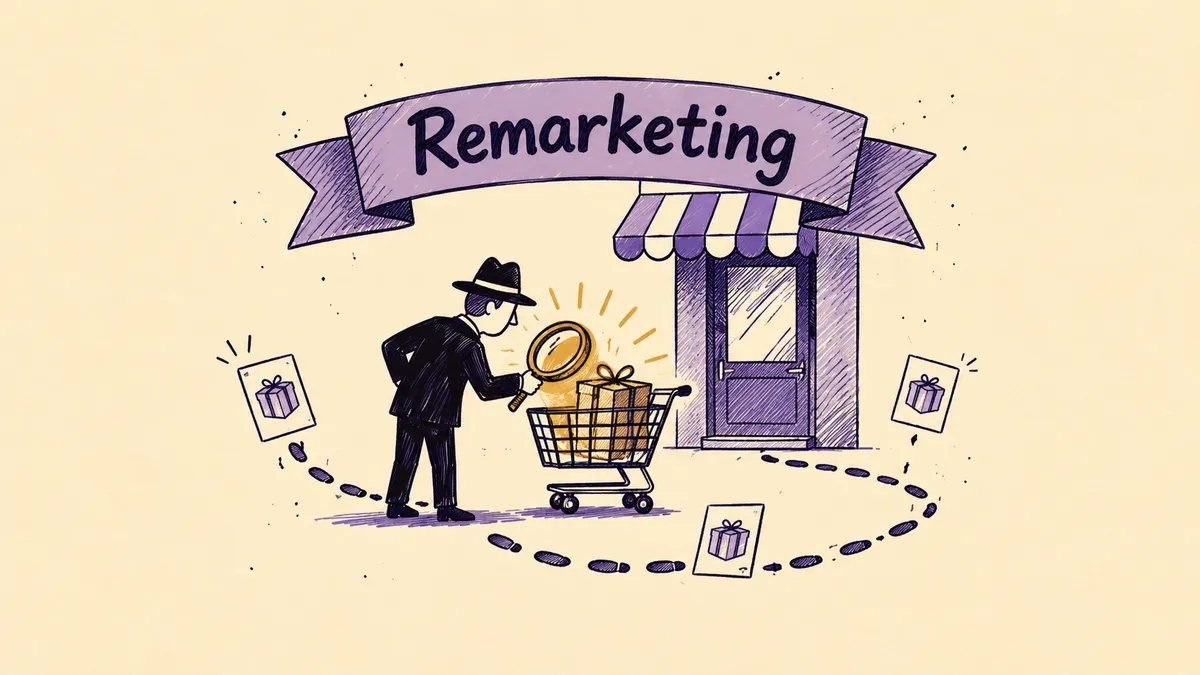
Remarketing (retargeting) means targeting ads at people who have already interacted with a business: they visited the website, used the app, watched a video or are on a customer list. The aim is to remind people who already knew the offer but did not take the expected action. A typical example is an ad for a product that the user added to the cart and did not buy. Remarketing is a form of personalised advertising, so it is subject to privacy rules.
In practice both terms mean the same thing. The name “remarketing” was used in Google Ads for years, while “retargeting” is its synonym used across the advertising industry. Google is gradually moving away from both names: in Google Ads remarketing is now called “your data segments”. In Meta Ads the equivalent is Custom Audiences.
How does remarketing work?
Remarketing works thanks to tracking code that adds visitors to audience lists. In Google Ads this is the Google tag with event snippets, and in Meta Ads it is the Meta pixel. Both can be installed through Google Tag Manager, among other methods. Based on rules, e.g. visits to a specific page, the system builds a list that the advertiser can target or exclude.
| Data source | Example audience list |
|---|---|
| Website visits | People who viewed a product page but did not buy |
| App | Users who installed the app and stopped using it |
| Video | People who watched the brand's video on YouTube |
| Customer list | Email addresses from the CRM matched to user accounts (Customer Match) |
| Conversions | Existing buyers, e.g. to exclude from acquisition campaigns |
What types of remarketing are there?
The most common types are standard, dynamic and search remarketing. Standard remarketing shows the same ad to the whole list. Dynamic remarketing shows the products the user viewed, using a product feed, e.g. from Google Merchant Center. Remarketing lists for search ads (RLSA) let you change bids and ads when a past website visitor searches on Google. You can also bid on broader keywords only for people who have already bought.
What rules apply to remarketing in Google Ads and Meta Ads?
Remarketing in Google Ads and Meta Ads has limits on how long people stay on a list and on the minimum list size. These limits protect user privacy and make it impossible to target ads at individual people.
| Parameter | Google Ads | Meta Ads |
|---|---|---|
| List name | Your data segment | Website Custom Audience |
| Code on the website | Google tag | Meta pixel |
| Default membership duration [days] | 30 | Set by the advertiser |
| Maximum membership duration [days] | 540 | 180 according to the API documentation |
| Minimum list size | 100 active users in the last 30 days | No data in the API documentation |
Google gives a threshold of 100 active users for the Display Network, Search and YouTube. It applies to lists uploaded or refreshed after 1 February 2024. The help article on search remarketing, however, still mentions a threshold of 1,000 cookies. It is therefore worth checking the list status in the account before planning a campaign. A person who returns to the website stays on the Google list for a newly counted period.
How can remarketing be used in a sales strategy?
Remarketing is used for more than recovering abandoned carts. Lists of existing customers make it possible to promote complementary products, i.e. to cross-sell. The same lists can also be excluded from campaigns aimed at new customers. Google cites the example of the Tirendo shop, which saw a 161% increase in conversion rate after using search remarketing.
What legal restrictions and policies apply to remarketing?
Remarketing requires the user's consent to cookies and is subject to personalised advertising policies. In Poland the rules for storing and reading information on the user's device are set out in Article 399 of the Electronic Communications Law. The act has been in force since 10 November 2024 and replaced the Telecommunications Law. Without consent, only cookies necessary to provide the service may be used; marketing cookies may not.
Consent must meet the GDPR standard: it must be freely given, unambiguous, specific and informed. Pre-ticked boxes and inaction do not constitute consent. For breaches, the President of UKE (the Polish electronic communications regulator) can impose a fine of up to 3% of annual turnover or up to PLN 1 million, whichever is higher. In practice, a user who rejects marketing cookies will not be added to a remarketing list.
Which categories cannot be used in Google remarketing?
Google prohibits creating audience lists based on sensitive categories. The personalised advertising policy lists, among others, health, religious beliefs, sexual orientation, political affiliation, financial hardship and gambling. For medical businesses this means they cannot target ads at lists of people who visited pages about diseases. In the US and Canada, additional restrictions cover housing, employment and credit ads.
The policy changes over time. Since 30 October 2026 Google has allowed personalisation of alcohol ads on YouTube where local law permits it. For now the change does not cover Poland, Egypt, India or Indonesia.
This entry is for information only and does not constitute legal advice.
Frequently asked questions
Q.What is the difference between remarketing and retargeting?
In practice there is none: both terms describe targeting ads at people who have previously interacted with a business. The name “remarketing” was used in Google Ads for years, and today Google Ads talks about “your data segments”. In Meta Ads the same mechanism is based on Custom Audiences built from pixel data.
Q.How long does a user stay on a remarketing list?
In Google Ads 30 days by default and up to 540 days on the Display Network and Search. Each subsequent visit to the website restarts this period. In Meta Ads the API documentation for website audiences gives a range of 1 to 180 days. The duration should match the typical purchase decision time in the industry.
Q.Does remarketing require cookie consent?
Yes. The cookies used for remarketing are not necessary for the website to work, so they require the user's consent. In Poland this follows from Article 399 of the Electronic Communications Law, in force since 10 November 2024. Consent must meet the GDPR standard, and pre-ticked boxes are not valid consent.
Q.Can remarketing be used in the medical sector?
To a limited extent. Google's personalised advertising policy classifies health as a sensitive category. An advertiser therefore cannot create audience lists based on interest in diseases or treatment. A medical facility can, however, run non-personalised campaigns, e.g. keyword-based Search campaigns.
Let's talk growth
Send a brief or drop your contact. We'll reply within 24h.
Get a quote