TOFU (Top of the Funnel)
TOFU (Top of the Funnel) is the first stage of the marketing funnel, where a potential customer learns about a problem, a product category or a brand. At this stage the audience is usually not yet ready to buy. The goal of TOFU activities is to build awareness and attract the attention of as wide a group of people as possible. The next stages of the funnel are MOFU (middle of the funnel) and BOFU (bottom of the funnel).
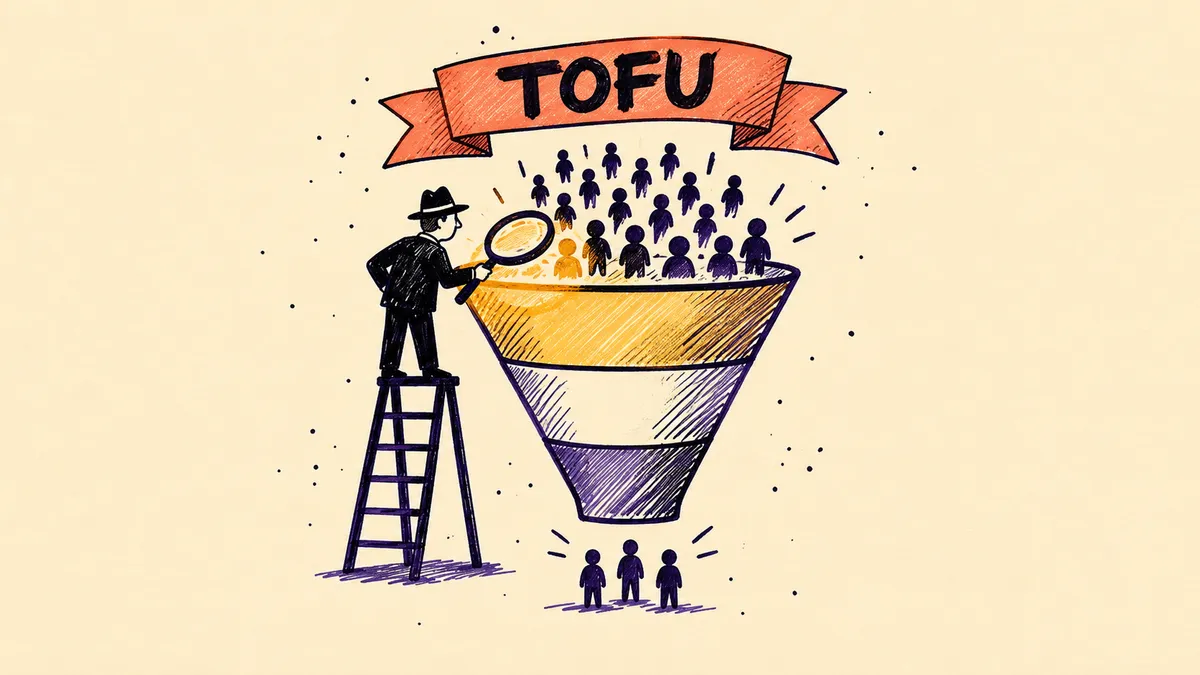
The concept of TOFU comes from the purchase funnel model. This model shows the customer journey as a narrowing triangle: the most people are at the top, and only some of them reach a purchase.
How does TOFU differ from MOFU and BOFU?
TOFU differs from the other funnel stages in the audience's readiness to buy and in the goal of communication. At the top of the funnel a brand answers questions about the problem, in the middle it helps compare solutions, and at the bottom it leads to a decision.
| Stage | Audience state | Goal | Typical content |
|---|---|---|---|
| TOFU (top) | Notices a problem or category | Awareness and reach | Guides, blog articles, video, social media posts |
| MOFU (middle) | Compares possible solutions | Interest and trust | Comparisons, case studies, webinars |
| BOFU (bottom) | Is close to a decision | Conversion | Offers, pricing, demos, customer reviews |
Where did the funnel model come from?
The source of the funnel is the AIDA model. According to EBSCO, its earliest forms were developed by American marketer Elias St. Elmo Lewis around 1898. In the 1920s the model was developed and popularized by Edward Strong. AIDA covers four stages: Attention, Interest, Desire and Action.
The model is usually drawn as an inverted triangle with the stages arranged from top to bottom. Hence the name purchase funnel and the division into top, middle and bottom. TOFU corresponds to the attention stage, i.e. the audience's first contact with the problem or brand.
What content and channels are used in TOFU?
TOFU uses content that answers the audience's general questions and problems instead of directly promoting an offer. At this stage people are looking for information, so a hard sell usually puts them off. Typical formats are:
- blog articles and guides answering informational questions;
- educational videos and podcasts;
- social media posts and user-generated content (UGC);
- industry reports, infographics and reach campaigns.
TOFU content topics are often chosen based on query popularity and trends. Tools such as Google Trends and analysis of informational search queries help here.
How to measure TOFU effectiveness?
TOFU effectiveness is measured mainly by reach and engagement, not by sales. Typical metrics are the number of new users, organic traffic from informational queries, impressions and reach. Engagement also counts, e.g. time on page or shares. The conversion rate, central to CRO, better describes the bottom of the funnel. TOFU content rarely leads to a purchase in the same session, so it is assessed with multi-channel attribution models.
Does the funnel model with TOFU still work?
The funnel model with TOFU is still used to plan content, but research shows that actual purchase paths are not linear. As early as 2009, McKinsey (Court et al.) noted that the funnel fails to capture all touchpoints and buying factors. Instead, it proposed a circular consumer decision journey.
The set of considered brands can grow
According to McKinsey, the number of brands under consideration can grow during evaluation rather than shrink. Computer buyers added on average about one brand to the initial 1.7 at this stage. Car buyers added 2.2 brands to the initial 3.8. A brand can therefore enter the game even after the customer has passed the TOFU stage.
The messy middle according to Google
Google (Rennie and Protheroe, 2020) described the space between trigger and purchase as the “messy middle”. Customers loop in it between exploration, which expands their options, and evaluation, which narrows them. They repeat this cycle as many times as they need to decide. The study involved a simulation of 310,000 purchase scenarios across five categories.
TOFU in the era of AI agents
The discovery stage is increasingly taken over by AI tools. According to BCG (2026), 96% of AI-assisted shoppers use AI precisely for product discovery. TOFU content must therefore be readable not only for people, but also for language models that summarize and recommend brands.
Frequently asked questions
Q.What does the abbreviation TOFU mean?
TOFU stands for Top of the Funnel. It denotes the first stage of the marketing funnel, where the audience learns about a problem, category or brand. The next stages are MOFU, the middle of the funnel, and BOFU, the bottom of the funnel. This division comes from the AIDA model from the turn of the 20th century.
Q.Does TOFU content generate sales?
TOFU content rarely leads to sales right away, but it builds an audience that may buy later. Its goal is awareness and reach, not immediate conversion. That is why it is assessed by reach, traffic and engagement. Its contribution to sales only shows up in multi-channel attribution models.
Q.How does TOFU differ from BOFU?
TOFU attracts people who are just learning about a problem, while BOFU leads people ready to buy to a decision. Guides and educational content dominate the top of the funnel. Offers, pricing, demos and customer reviews dominate the bottom. The effectiveness measures differ too: reach at the top, conversion at the bottom.
Q.Is the marketing funnel still relevant?
The funnel remains a useful planning tool, but it does not accurately describe actual purchase paths. As early as 2009, McKinsey showed that the number of brands under consideration can grow during evaluation. Google described loops of exploration and evaluation in the messy middle model. In 2026, the discovery stage is increasingly taken over by AI tools.
Let's talk growth
Send a brief or drop your contact. We'll reply within 24h.
Get a quote