Breadcrumb Links
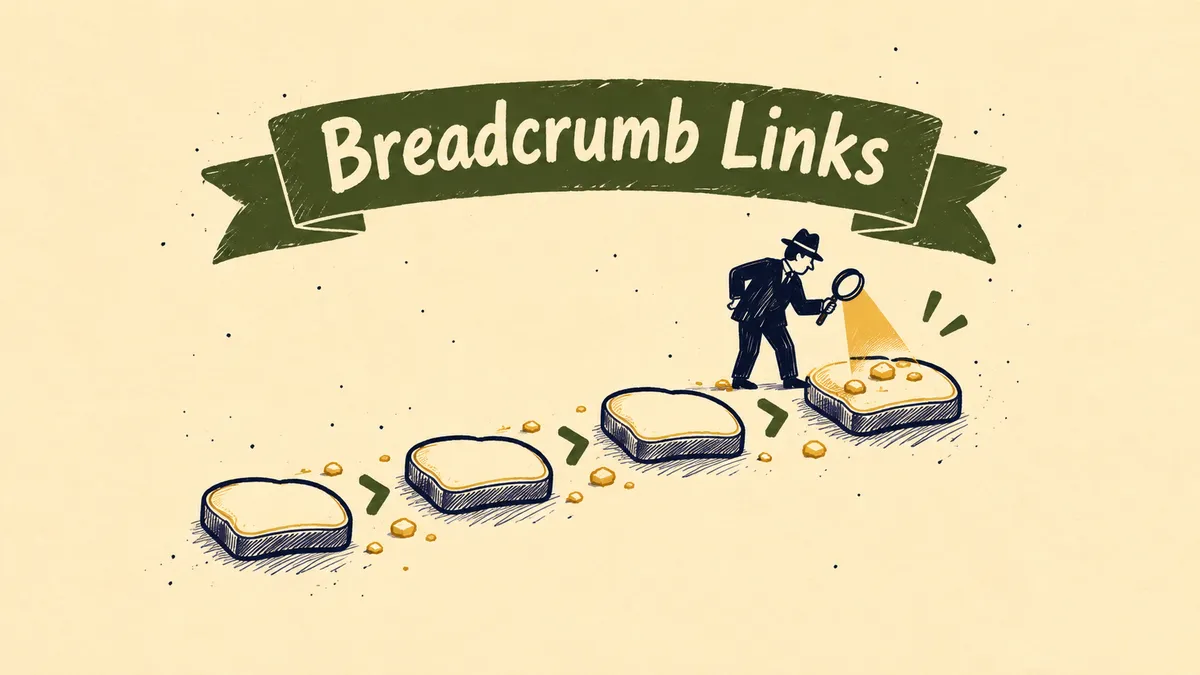
Breadcrumb Links (breadcrumb navigation, breadcrumbs) are a list of links showing where the current page sits in a site's hierarchy. Nielsen Norman Group defines them as a list of links to the current page and its “ancestors”, usually all the way up to the homepage. The trail is usually placed above the page content. An example for a product page: Home › Shoes › Running shoes › Model X. Breadcrumbs help users return to higher levels of the site, and Google uses them to describe the page in search results.
What should breadcrumb navigation look like?
Breadcrumb navigation should show the page's position in the site hierarchy, not the history of visited pages. That is one of Nielsen Norman Group's 11 guidelines for breadcrumbs on desktop and mobile. NN/g calls breadcrumbs a secondary form of navigation. They do not replace the main menu; they complement it.
Rules for building the trail
NN/g sets out several specific rules:
- the trail starts with a link to the homepage;
- the last element is the current page, and it is not a link;
- each earlier element is a link to a parent page;
- logical categories without their own page are left out of the trail;
- when several paths are possible, only one is shown.
The current page should be visually distinct from the links, which NN/g recommends marking with an underline or blue color. NN/g stresses that a link that does nothing confuses users.
When are breadcrumbs unnecessary?
According to NN/g, breadcrumbs are not needed on flat sites with one or two levels. They are not useful in linear structures either. They deliver the most on large sites, e.g. stores with multi-level categories. They especially help people who land on a page from an external link rather than through the homepage.
Breadcrumbs on mobile devices
On phones, the breadcrumb trail should not wrap onto several lines. A multi-line breadcrumb takes up space and shows the structure of the chain poorly. The elements can also be too small to tap comfortably. In that case NN/g recommends shortening the trail, if users' tasks allow it.
How does Google use breadcrumbs in search results?
Google uses breadcrumb markup in the body of a page to categorize information about it in search results. That is how the Google Search Central documentation describes it (updated 8 September 2026). According to Google, a breadcrumb trail indicates the page's position in the site hierarchy. It also lets users navigate up the structure, one level at a time.
BreadcrumbList structured data
For Google, a breadcrumb trail is described with the BreadcrumbList type from the Schema.org vocabulary. The list must contain at least two ListItem elements.
| Type | Required properties | Meaning |
|---|---|---|
| BreadcrumbList | itemListElement | Container with the list of trail elements |
| ListItem | position | Order of the element in the trail |
| ListItem | name | Name shown to the user |
| ListItem | item | URL of the page at that level |
Google supports JSON-LD, Microdata and RDFa. A JSON-LD example for the trail Books › Science Fiction › Award Winners:
<script type="application/ld+json">
{
  "@context": "https://schema.org",
  "@type": "BreadcrumbList",
  "itemListElement": [{
    "@type": "ListItem",
    "position": 1,
    "name": "Books",
    "item": "https://example.com/books"
  },{
    "@type": "ListItem",
    "position": 2,
    "name": "Science Fiction",
    "item": "https://example.com/books/sciencefiction"
  },{
    "@type": "ListItem",
    "position": 3,
    "name": "Award Winners"
  }]
}
</script>
In Google's example the last element, i.e. the current page, has no item property.
How do you implement breadcrumbs correctly?
A correct breadcrumb implementation combines a visible trail of links for users with structured data for Google. Google's documentation recommends that breadcrumbs reflect a typical user path to the page. They do not have to mirror the URL structure. You also do not need to add an element for the domain or for the current page itself.
Several paths to one page
A single page can sit in several places on a site, e.g. a product in two categories. Google then allows several BreadcrumbList lists in the structured data of the same page. NN/g, however, recommends that the visible trail show users only one path. This applies especially to product pages in online stores.
Testing and monitoring
Structured data code is checked in the Rich Results Test. Google recommends fixing critical errors and considering fixes for warnings. Warnings alone do not exclude a page from rich results. The state of structured data across the whole site can be monitored in Google Search Console.
In CMS platforms, breadcrumbs and their markup may be generated by the theme or an SEO plugin. After changes to the category structure, it is worth checking that the trails and structured data still match. This is one of the checkpoints of an SEO audit.
Sources
- Google Search Central - How To Add Breadcrumb (BreadcrumbList) Markup, updated 8 September 2026.
- Nielsen Norman Group - Breadcrumbs: 11 Design Guidelines for Desktop and Mobile.
- Schema.org - BreadcrumbList.
Frequently asked questions
Q.Should the last breadcrumb element be a link?
No, the last element of the trail is the current page and, according to Nielsen Norman Group, it should not be a link. A link that leads to the same page does nothing and confuses users. The current page should be visually distinct from the earlier elements. In Google's structured data, the last element may have no URL.
Q.Do breadcrumbs have to match the URL structure?
No, Google recommends that breadcrumbs show a typical user path to the page rather than copy the URL structure. You also do not need to add an element for the domain or for the page itself. What matters is that each element of the trail leads to an existing parent page. Categories without their own page are left out.
Q.Are breadcrumbs the same as the main menu?
No, breadcrumbs are a secondary form of navigation that shows where a page sits in the site hierarchy. The main menu leads to the most important sections and repeats on every page. Breadcrumbs complement the menu, especially when a user lands on a page from an external link. They do not replace the main navigation.
Q.How many elements must a BreadcrumbList have?
According to Google's documentation, a BreadcrumbList must contain at least two ListItem elements. Each element requires the position, name and item properties. The code is checked in the Rich Results Test. Critical errors should be fixed before expecting the trail to appear in Google.
Let's talk growth
Send a brief or drop your contact. We'll reply within 24h.
Get a quote