Product page
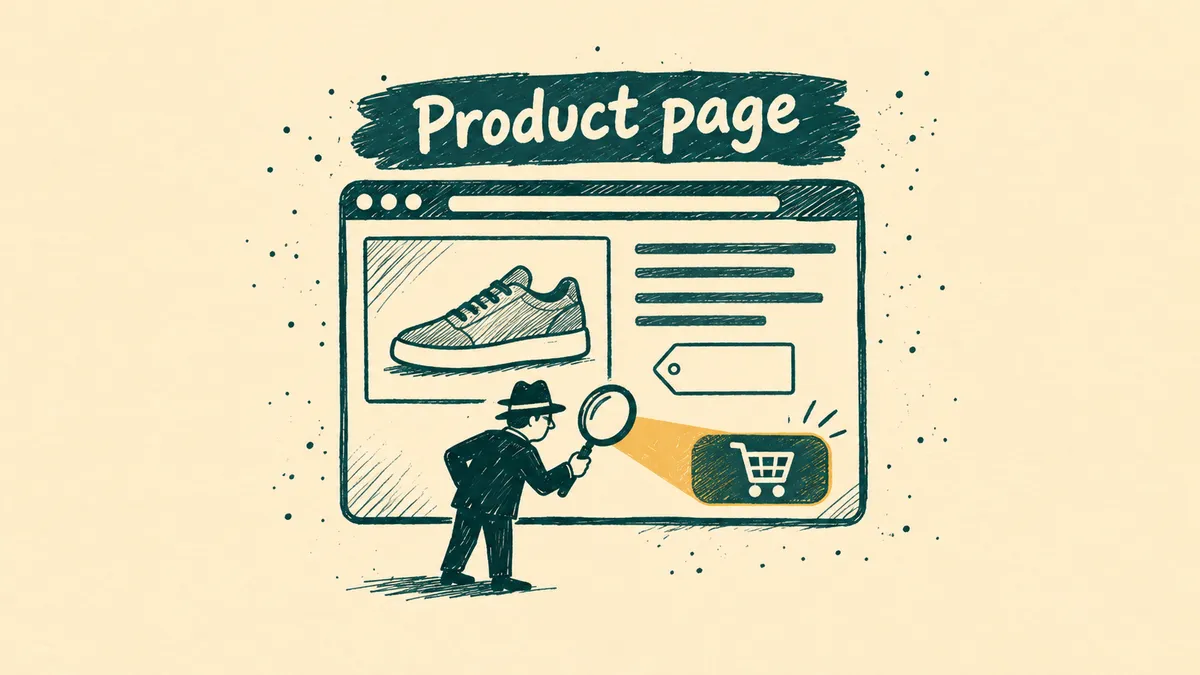
A product page is an online store subpage dedicated to a single product, where the customer can view and buy it. It contains the name, photos, description, price, availability, variants and an add-to-cart button. In the European Union some information on a product page is mandatory, e.g. the main characteristics of the goods and the total price including taxes. It is also called a product detail page (PDP); in Polish it is known as karta produktu.
What is a product page?
The product page is where the customer makes the purchase decision. They reach it from a store category, a search engine, a shopping ad or a price comparison site. A good product page answers the customer's questions before they get the chance to ask them.
| Element | What it is for |
|---|---|
| Product name | identifies the product and usually forms the page's H1 heading |
| Photos and video | replace seeing the product in a store |
| Price and availability | show how much the product costs and whether it is in stock |
| Variants | let the customer choose a size, color or capacity |
| Description and specification | give the product's features, parameters and uses |
| Delivery and returns | cover delivery costs and times and return conditions |
| Customer reviews | show the experiences of other buyers |
| Buy button | adds the product to the cart |
| Related products | suggest accessories and alternatives |
In stores built on popular platforms, the product page is generated from a template. The same layout displays data from the product database, so a single change to the template applies to all products at once.
What information must a product page contain?
A product page in an online store must contain the information required by European Union consumer law. Directive 2011/83/EU on consumer rights (Art. 6(1)) lists, among other things, the main characteristics of the goods and the total price including taxes. The price must be accompanied by transport and delivery costs or a statement that such costs may apply.
Some of this information has to be shown at a specific moment. Under Art. 8(2) of the directive, the trader provides it in a clear and prominent manner directly before the order is placed. The order button must clearly indicate an obligation to pay, e.g. with the words “order with obligation to pay”.
A separate rule applies to price reductions. The Omnibus Directive (2019/2161) added Art. 6a to Directive 98/6/EC. Under it, every announcement of a price reduction must state the prior price.
| Provision | What it means for the product page |
|---|---|
| Directive 2011/83/EU, Art. 6(1)(a) | main characteristics of the goods in the description |
| Directive 2011/83/EU, Art. 6(1)(e) | total price including taxes and delivery costs |
| Directive 2011/83/EU, Art. 8(2) | key information right before the order, a button stating the obligation to pay |
| Directive 98/6/EC, Art. 6a (added by Directive 2019/2161) | with a reduction, the prior price, i.e. the lowest price in at least the 30 days before the reduction |
Under Art. 6a, the prior price is the lowest price applied during a period of not less than 30 days before the reduction. Member States may adopt different rules for, among others, goods that perish quickly and products that have been on offer for less than 30 days.
How does a product page affect SEO?
The product page is the landing page for queries about a specific product, so its content determines the store's visibility in Google. What counts is a unique description, a clear name in the title and heading, and structured data.
Google describes two types of structured data for products in its Search Central documentation. They make it possible to show, among other things, the price, availability, ratings and shipping information in search results.
| Data type | For which pages | What it can describe |
|---|---|---|
| Product snippets | product pages without a purchase option, e.g. reviews | ratings, reviews, pros and cons |
| Merchant listings | pages where the customer buys the product | apparel sizes, shipping, return policies |
In practice, a store's product page uses the Product type with offer properties from the Schema.org vocabulary. According to Google, adding the required properties for merchant listings usually makes the page eligible for product snippets as well.
The data on the product page should match the data in the product feed submitted to Google Merchant Center. This applies especially to price and availability, because the same products appear in ads and in free shopping listings.
How does a product page affect conversion?
The product page is one of the main areas of work in CRO (Conversion Rate Optimization). This is where the customer decides whether to add the product to the cart.
- Photos from several angles and in use reduce uncertainty about how the product looks.
- Customer reviews and photos, i.e. UGC (user-generated content), provide social proof.
- Delivery cost and time shown next to the price reveal the full cost of the purchase before the cart.
- A related products section delivers cross-selling and raises the order value.
- Fast page loading, measured e.g. in PageSpeed Insights, is especially important on phones.
Changes to a product page are best checked with A/B tests. This shows whether a new layout actually increases the number of products added to the cart.
Frequently asked questions
Q.How is a product page different from a product description?
The product description is only one element of the product page. The product page is the whole store subpage: name, photos, price, variants, delivery, reviews and buy button. The description is the text that presents the product's features, parameters and uses. In SEO the description matters a lot, because it is usually the largest piece of unique content on the page.
Q.Which price must be shown during a promotion?
With a price reduction, you must state the prior price, i.e. the lowest price in at least the 30 days before the reduction. This follows from Art. 6a of Directive 98/6/EC, added by the Omnibus Directive 2019/2161. EU Member States may adopt different rules for, among others, perishable products and products new to the offer.
Q.What structured data should a product page have?
A store's product page uses the Product type with an offer, which Google calls a merchant listing. It describes, among other things, price, availability, shipping and return policies. According to Google's documentation, the full set of required properties for merchant listings usually also makes the page eligible for product snippets with ratings.
Q.Can I copy the manufacturer's description?
You can, but such a description will not make the store stand out in search results. The same manufacturer text usually appears at many sellers, so the page adds no new information. It is better to supplement it with your own content: uses, a comparison of variants, answers to customer questions and reviews.
Let's talk growth
Send a brief or drop your contact. We'll reply within 24h.
Get a quote