Cross-selling
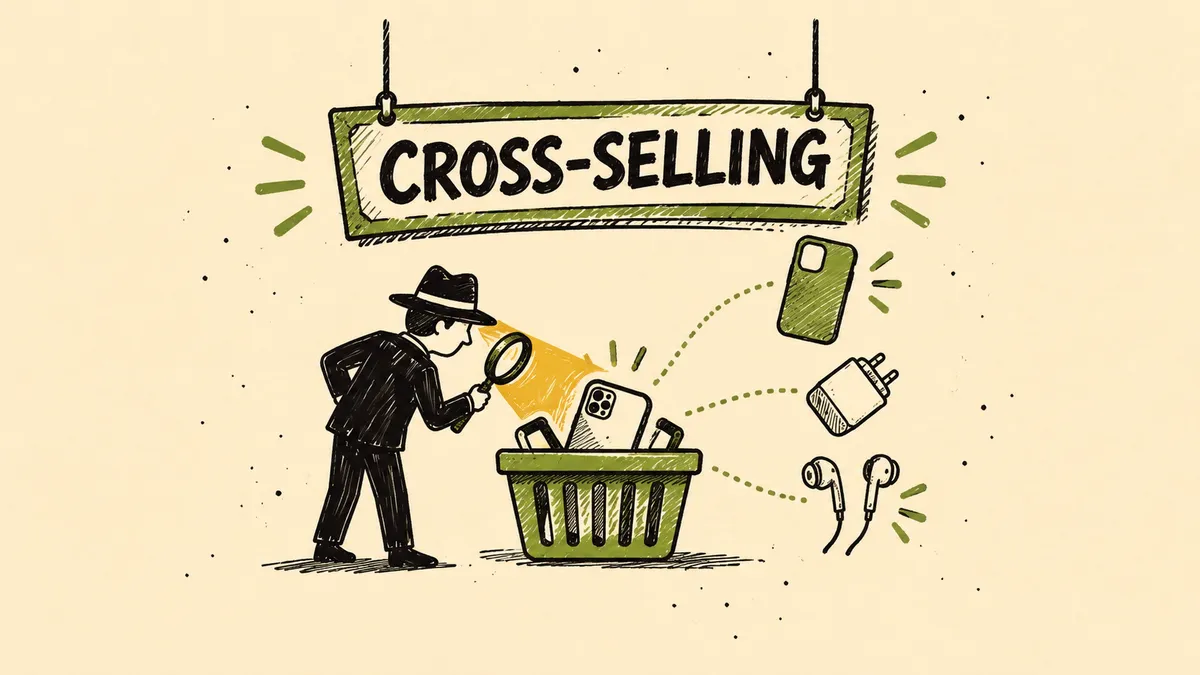
Cross-selling is offering a customer products or services that complement what they are buying or have already bought. An example is suggesting a case for the phone being purchased. The goal is a higher order value and an offer better matched to the customer's needs. In e-commerce, cross-selling most often works through recommendations such as “Frequently bought together”. In financial services and insurance, cross-selling is regulated by European Union law.
What is cross-selling?
Cross-selling is a sales technique in which the customer receives an offer of a product related to their purchase. The Merriam-Webster dictionary defines “cross-sell” as selling or promoting a different or related product or service to an existing customer. The offer can come before the purchase, in the cart or after the purchase.
| Feature | Description |
|---|---|
| Polish name | sprzedaż krzyżowa |
| Type | a sales and marketing technique |
| Aimed at | a customer who is buying or has already bought |
| What is offered | a complementary product or service |
| Goal | higher order and customer value |
| Related terms | upselling, mixed bundling, pure bundling |
| EU regulation | MiFID II (investment services), IDD directive (insurance) |
Cross-selling relies on relationships between products. A memory card goes with a camera, property insurance with a mortgage, and a consultation with a trainer with an online course. The better the offer meets the customer's need, the greater the chance of an additional purchase.
How is cross-selling different from upselling?
Cross-selling offers an additional product, while upselling offers a more expensive or better version of the same product. Both techniques raise the order value, but they do it differently.
| Feature | Cross-selling | Upselling |
|---|---|---|
| What it offers | a complementary product | a higher version of the same product |
| Example with a laptop | a bag and a mouse | a model with more memory |
| Number of products in the order | increases | usually the same |
| Typical place in the shop | product page, cart, post-purchase email | product page, variant comparison |
Cross-selling should also be distinguished from package sales. The ESMA guidelines distinguish two types of packages. In mixed bundling, each component of the package can be bought separately. In pure bundling, at least one component is not available on its own.
How does cross-selling work in e-commerce?
Online shops offer complementary products at several points of the purchase path. In its guide, Shopify lists, among others, “Frequently bought together” sections, cart recommendations and add-ons at checkout.
| Place | Example offer |
|---|---|
| Product page | a “Frequently bought together” or “Goes well with” section |
| Cart | accessories for the products in the cart |
| Checkout | a cheap one-click add-on, e.g. a warranty |
| After purchase | an email with products for the item bought |
| Advertising | a remarketing campaign with accessories for buyers |
Offers are chosen manually or automatically. Recommendation systems analyse purchase histories and point to products frequently bought together. According to a 2013 McKinsey report, 35% of purchases on Amazon came from algorithm-based product recommendations.
Cross-selling is one of the tools of CRO (Conversion Rate Optimization) when the goal is a higher cart value.
How do you measure the effectiveness of cross-selling?
The effectiveness of cross-selling is measured by the change in the value and number of products in an order. Orders with and without the additional product are compared, or a test group with a control group in an A/B test.
| Metric | What it shows |
|---|---|
| Average order value (AOV) | revenue divided by the number of orders |
| Number of products per order | whether customers buy more items |
| Share of orders with an add-on | how often customers accept the offer |
| Revenue from recommendations | what share of sales the offers generate |
| ROI (return on investment) | whether the profit from additional sales exceeds the cost of the activities |
In shops with e-commerce analytics, order and product data is usually collected in Google Analytics 4. It is worth tagging recommendations separately, e.g. with a product list name, to tell their sales apart from regular purchases.
How do regulations govern cross-selling?
In consumer sales in the EU, an additional payment requires the customer's express consent. Directive 2011/83/EU on consumer rights (Article 22) gives the consumer the right to a refund of a payment charged through a pre-ticked option. That is why an add-on in the cart cannot be pre-selected. Investment services and insurance are subject to additional rules on cross-selling.
The MiFID II directive defines a cross-selling practice as offering an investment service together with another service or product, as part of a package or as a condition of the agreement. The details are set out in the ESMA guidelines on cross-selling practices, applicable from 3 January 2018.
The IDD directive on insurance distribution devotes Article 24 to cross-selling. When insurance is offered together with another product, the distributor informs the customer whether the components can be bought separately. It also provides a separate breakdown of costs and charges for each component.
| Act | What it covers |
|---|---|
| MiFID II, Article 4(1)(42) | definition of a cross-selling practice in investment services |
| ESMA Guidelines 2016/574 | mixed and pure bundling of investment services, applicable from 3.01.2018 |
| IDD Directive 2016/97, Article 24 | information on the option to buy separately and on the costs of the components of a package with insurance |
In Poland, the IDD directive was implemented by the Act of 15 December 2017 on insurance distribution.
Sources
- The definition of “cross-sell” is given by the Merriam-Webster dictionary.
- The places where shops offer products are described in Shopify's guide to cross-selling.
- The Amazon data comes from the 2013 McKinsey article “How retailers can keep up with consumers”.
- The legal rules are set out in ESMA Guidelines 2016/574, IDD Directive 2016/97 and Directive 2011/83/EU on EUR-Lex.
Frequently asked questions
Q.What is an example of cross-selling?
A typical example is offering a case and a charger when someone buys a phone. In an online shop, the offer usually appears in a “Frequently bought together” section or in the cart. In banking, an example is offering insurance with a loan. In digital services, such an add-on may be implementation or training for the software purchased.
Q.Can cross-selling and upselling be combined?
Yes, shops often use both techniques on one purchase path. On the product page, the customer sees a more expensive variant, which is upselling. In the cart, they get an offer of accessories, which is cross-selling. Both techniques raise the order value, but each needs its own measurement of effectiveness.
Q.Can an additional product be pre-selected in the cart?
No, if it involves an extra charge for the consumer. Directive 2011/83/EU on consumer rights requires express consent to every additional payment. If a shop inferred consent through a pre-ticked option, the consumer is entitled to a refund of that payment. The offer must therefore be the customer's choice.
Q.What is the difference between mixed bundling and pure bundling?
In mixed bundling, each component of the package can be bought separately. In pure bundling, at least one component is not available on its own. This distinction is used by the ESMA guidelines on cross-selling of investment services. Classic cross-selling in an online shop is usually an offer of a product the customer can buy separately.
Let's talk growth
Send a brief or drop your contact. We'll reply within 24h.
Get a quote