Chunking content
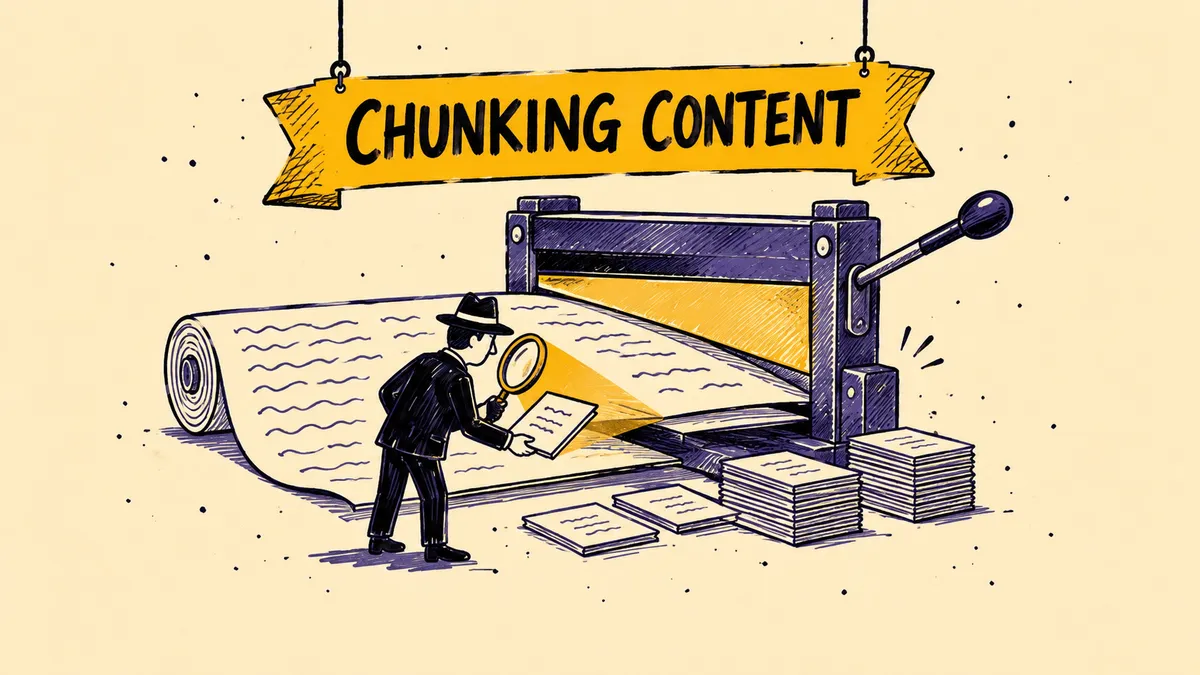
Chunking content means dividing text into short, clearly separated fragments, each dealing with one idea. Headings, short paragraphs, lists and tables help with this. Nielsen Norman Group defines chunking as breaking content into small, distinct units of information instead of a uniform mass of text. The concept comes from cognitive psychology, and today it is also used in the context of search engines and AI models.
Where does the concept of chunking come from?
In cognitive psychology, a chunk is a unit that organises information in memory. In 1956 George Miller described short-term memory as holding about 7 such units. A more important finding, however, was that the size of the units did not matter. People remembered 7 single letters or 28 letters combined into 7 words.
Later research lowered this number. In 2001 Nelson Cowan suggested that working memory holds about 4 chunks. NN/g warns against taking these numbers literally, e.g. as a limit of 7 items in a menu. The point of chunking is grouping related information, not rigidly counting elements.
How do you apply chunking to content?
Nielsen Norman Group lists several techniques that make reading and remembering easier:
- short paragraphs separated by white space,
- lines of text about 50–75 characters long,
- clear headings and subheadings,
- bulleted or numbered lists,
- highlighting keywords in bold,
- a short summary at the start of a longer text,
- grouping digits, e.g. a phone number 448 732 453 instead of 448732453.
Well-divided text lets the reader quickly find the part they need. Each section should answer one question and be understandable without reading the rest. The structure of headings and content is worth checking as part of an SEO audit.
What is chunking in search engines and AI models?
In technology, chunking means dividing documents into fragments by the system, not by the author. This is how solutions such as RAG, retrieval-augmented generation, work. The system splits text into fragments, selects those that best match the question and passes them to a language model. The model creates an answer based on them.
Search engines also assess individual parts of pages. In 2020 Google announced that it can identify a relevant passage of a long page, so-called passage ranking. That is why sections with a clear heading and a specific answer are easier to match to a query.
Is it worth chunking content specifically for AI?
Google advises against creating content cut into small pieces solely with language models in mind. In January 2026 Danny Sullivan spoke about this on the “Search Off the Record” podcast. In his view, Google's systems will reward content written for people. He also advised against preparing two versions of a text: one for models and one for users.
Chunking therefore makes sense as a way to improve readability, not as a trick for algorithms. Breaking a topic into many short, thin pages can do harm. Low-value pages have for years been demoted by, among others, the Google Panda algorithm.
What mistakes are made when chunking?
The most common problems come from overdoing the division of text:
- fragments without context – a section cannot be understood without the previous one,
- headings that do not match the content – they promise an answer the section does not give,
- lists instead of explanations – points without reasons or examples,
- repeating the same information in every section,
- separate pages for each fragment instead of one comprehensive page.
A readable content layout also affects user behaviour on the site. Changes to it can be tested as part of CRO.
Sources
- Moran K., “How Chunking Helps Content Processing”, Nielsen Norman Group, 2016. nngroup.com
- Miller G.A., “The magical number seven, plus or minus two”, Psychological Review, 1956.
- Cowan N., “The magical number 4 in short-term memory: A reconsideration of mental storage capacity”, Behavioral and Brain Sciences, 2001. pubmed.ncbi.nlm.nih.gov
- Search Engine Land, “Google doesn’t want you to create bite-sized chunks of your content”, January 2026. searchengineland.com
- Google, announcement on ranking passages of pages (passage ranking), Search On, October 2020.
Frequently asked questions
Q.What does chunking mean?
Chunking means portioning or grouping information. The term comes from the English word chunk, meaning a piece. In psychology it means combining single elements into larger units that are easier to remember. In content writing it means dividing text into short, clearly separated parts with headings and lists.
Q.How much information does short-term memory hold?
In 1956 George Miller described about 7 items, plus or minus 2. In 2001 Nelson Cowan suggested that working memory holds about 4 chunks of information. This does not mean a section of text can have at most 4 or 7 points. What counts is grouping related information, not a rigid limit.
Q.Does chunking help with rankings?
Indirectly yes, if it makes reading easier. Since 2020 Google has been able to assess individual passages of pages, so well-separated sections can be matched to a query on their own. Google's Danny Sullivan, however, advises against creating small pieces specifically for AI models. According to him, the systems are meant to reward content written for people.
Q.How long should a single fragment of text be?
There is no single right length. NN/g recommends short paragraphs separated by white space and lines of text about 50–75 characters long. Each section should deal with one topic and be understandable without reading the rest. In AI systems, the fragment size is set by the system's creator, not by the author of the text.
Let's talk growth
Send a brief or drop your contact. We'll reply within 24h.
Get a quote