Google AI Overviews in practice: the mechanism, decision gates and an action plan

A Google AI Overview is created only when it passes two gates described in Google patents. The first decides, before generation, whether a summary will be created at all and in what form. The second checks the finished text and attributes it to sources. For SEO this gives a simple rule: first check whether the query has a summary, and only then rewrite the text to get cited.
What two gates does an AI answer pass through?
An AI answer in Google passes through two gates: one before the text is generated and one after. This is a simplified model built on descriptions from Google patents. It is not an official diagram of how the search engine works.
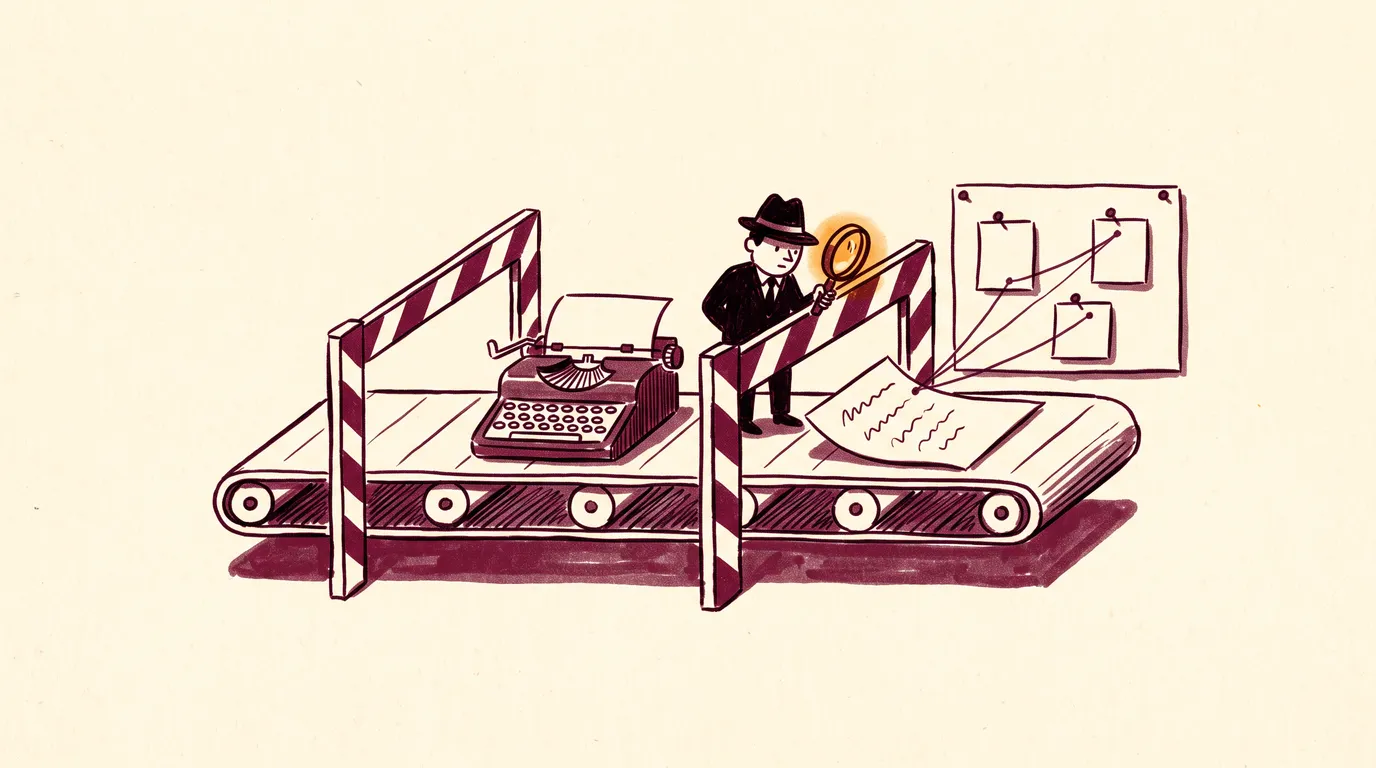
The first gate covers two steps. The system decides whether a summary is created at all before the model writes a single sentence. The query class affects the form of the answer, e.g. splitting it into sub-queries or topics. It does not decide that there will be no answer.
The second gate works only on the finished text. The system compares it with fragments of sources and attributes claims to specific pages. A query can therefore pass the first gate while your page still does not make it into the summary's links.
Google confirms in its Search Central documentation that an AI Overview appears only when it adds something beyond the classic results. It also notes that summaries often do not trigger.
What stages of creating an AI Overview do Google patents describe?
Google patents describe six stages that affect whether an AI answer is created and with which sources. Two work before generation, four after it.
| Stage | When it works | Patents |
|---|---|---|
| 1. Summary from search results | before generation | US20250005303A1, US11769017B1, US12524452B1 |
| 2. Query class changes the form | before generation | CN121986331A, WO2025080561A1, US20250348504A1 |
| 3. Revision and attribution to sources | after generation | CN120051770A, US11769017B1 |
| 4. Consistency of multiple outputs | after generation (analogy) | WO2025178619A1 |
| 5. Ratings of fragments feed back into the system | after generation | US20250252271A1 |
| 6. Linked sources as a trace of selection | after generation | US20250005303A1, CN120051770A |
1. The summary is built from search results
Patent US20250005303A1 describes selecting generative models based on the query or on documents from the results. It also provides for a situation in which the system uses no model at all. Patent US11769017B1 combines the model's input with the query and the content of the documents that match it.
Patent US12524452B1 concerns a conversation with a language model. It does not describe AI Overviews themselves. It describes topic classification and an answer based on a summary of earlier conversations. None of these patents contains a list of queries excluded from AI answers.
2. The query class changes the form of the answer
Patent WO2025080561A1 describes splitting a complex question into sub-queries selected by diversity and relevance to the question. Patent US20250348504A1 describes a results page organised by topics generated by the model. Patent CN121986331A makes triggering such a path depend on, among other things, the quality of results and server load.
The query class therefore controls the form of the answer, not whether there is one. The claim that product queries by definition get no summary does not follow from these descriptions. Semrush data also show that the share of informational queries among those with an AI Overview fell from 89.03% in October 2024 to 57.16% in October 2025.
3. Revising the text and attributing it to sources
Patent CN120051770A describes correcting text from the model by comparing it with fragments of sources. The system attributes these fragments to the text and decides whether to release the corrected version. Patent US11769017B1 adds confidence measures for fragments of the summary, based on agreement with the sources.
This is a check of the finished text. Whether the model runs is decided at an earlier stage. A claim blurred across a long paragraph is harder to pin to a specific sentence on the page.
4. Consistency of multiple outputs (analogy)
Patent WO2025178619A1 describes selecting an answer by the consistency of multiple outputs for the same task. It concerns model-driven tools, though, and does not describe AI Overviews. So it is an analogy and does not describe how summaries work.
If a similar measure works for AI Overviews, a topic with conflicting sources produces fewer consistent versions of the answer. Such a query is better treated as a risk than as an easy opportunity.
5. Ratings of fragments feed back into the system
Patent US20250252271A1 describes users rating specific fragments of a model's answer, including images or video. These ratings can be used to train or fine-tune the model. Answers are therefore not frozen. A “no AI Overview” result describes only the day of the check.
6. Linked sources as a trace of document selection
Patent US20250005303A1 describes selecting documents and fragments from the results that form the model's input. Patent CN120051770A describes attributing source fragments to the finished text. The list of links in the summary is the only trace of this selection visible from outside. It does not show how ranking works, yet it tells you who is already in the answer.
How do you plan work on a query for AI Overviews?
The action plan starts with checking the query. Rewriting the text comes later. Type the query into a browser window without a signed-in account and note the date, whether there is a summary and the linked domains.
| Do | Why |
|---|---|
| rewrite the text when there is a summary and you are missing from its links | that is where the second gate works, attributing the text to sources |
| put each claim in a separate sentence | revision compares the text with individual source fragments |
| answer each aspect of the question separately | splitting into sub-queries selects them by diversity and relevance |
| compare how consistent the sources in the results are | conflicting sources may produce fewer consistent answers (analogy) |
| Avoid | Why |
|---|---|
| ruling out product queries by assumption | the patents describe topic-organised answers for them |
| treating a single check as a verdict | the model is fine-tuned on user ratings |
| rewriting text for a query without a summary | there the work goes into the classic ranking |
Go back to queries with a “no summary” result before every decision on a content budget. According to Semrush, from November 2025 to April 2026 the share of results with an AI Overview for commercial queries grew by 71% on average. A verdict from a few months ago may be out of date.
Remember the technical condition too. According to Google, a page must be indexed and eligible to be shown with a text snippet. The nosnippet, data-nosnippet, max-snippet and noindex directives limit its participation in AI features.
You will see the effects of work on a query in Google Search Console and in your site traffic. The free GA4 audit checks whether your GA4 tag collects correct data.
What do Google patents not prove?
The patents do not describe a classifier that would switch off AI Overviews for medical, financial or legal topics. Nor do they give a threshold at which the system abandons an answer because of weak sources. The absence of a summary for navigational and product queries and some YMYL topics is an observation by practitioners. The patents do not describe such a mechanism.
A patent defines the scope of legal protection. It does not say how Google works today. Google stresses in its documentation that AI Overviews require no special optimisation and that SEO fundamentals still apply. The gate model described here is therefore a tool for planning work. It does not guarantee a citation.
Frequently asked questions
Q.Does a top 10 position guarantee a link in an AI Overview?
No. A page can be in the classic results and still miss the summary's links. According to Google patents, the finished text is compared with fragments of sources and attributed to them. What counts is whether the page has a sentence that directly confirms a claim from the summary.
Q.Do you need to optimise content specifically for AI Overviews?
Google says you do not. According to the Search Central documentation, AI Overviews require no special optimisation and SEO fundamentals still apply. The page must be indexed and eligible to be shown with a text snippet. The patents suggest, however, that a clear structure helps: one claim per sentence and a separate answer to each aspect of the question.
Q.Can you switch off AI Overviews for your site?
You cannot switch off the summary itself in the results, yet you can limit your page's participation in AI features. Google points to the nosnippet, data-nosnippet, max-snippet and noindex directives for this. Each of them also limits ordinary snippets in search results. The decision is therefore worth making deliberately, for selected pages or fragments.
Q.Where can you see AI Overview traffic in Google Search Console?
Google counts traffic from AI features, including AI Overviews, in the performance report in Google Search Console. You will find the data under the “Web” search type, together with traffic from classic results. Whether a specific query has a summary has to be checked in the results themselves or in rank tracking tools.
Sources
- Google Search Central, “AI features and your website”, updated 10.12.2025. developers.google.com
- Semrush, “Semrush AI Overviews Study: What 2025 SEO Data Tells Us About Google’s Search Shift”. semrush.com
- Semrush, “AI Overviews are expanding across commercial intent search”, 2.07.2026. semrush.com
- Google patents: US20250005303A1, US11769017B1, US12524452B1, CN121986331A, WO2025080561A1, US20250348504A1, CN120051770A, WO2025178619A1, US20250252271A1. patents.google.com
More on SEO and AI search
- New Google materials for SEO: search traffic, CDN and “things to do”
- How to increase your brand's visibility in ChatGPT and Google AI Overview
- Google Lighthouse update changes how PageSpeed Insights simulates loading
- AI Search: how AI-powered search works
- AI hallucinations: causes and safeguards
- Duplicate content and AI citations: what Google patents say
- How Much Does SEO Cost: Pricing Guide and Red Flags to Watch For
- ChatGPT Ads: how the channel works and how to run a first test worth learning from
- GEO: Will Your Brand Disappear From Results If You Don't Optimize for AI?

Zanim zaplanuje treść pod AI Overview, sprawdza, czy dla frazy podsumowanie w ogóle się pojawia i które domeny są w jego linkach.
LinkedInRelated articles
Let's talk growth
Send a brief or drop your contact. We'll reply within 24h.
Get a quote