Duplicate content and AI citations: what Google patents say

Duplicate content can be cited in an AI answer, mainly as evidence for a specific claim. It less often enters the set as a new source. Google patents describe two stages that treat repetition in opposite ways. When passages are selected for synthesis, diversity counts, so a copy of information already chosen probably loses its slot. During verification and attribution, the same information can support a specific sentence of the answer. Patents describe the scope of legal protection and do not by themselves confirm how AI Overviews and AI Mode work.
Is duplicate content filtered out when passages are selected for an AI answer?
Duplicate content probably loses during passage selection, yet the described solutions do not provide for a penalty. Three patents show three different measures of repetition: against the set, against the corpus and against the user's history. None of them means a page is excluded automatically.
Diversity of the source set
Patent US20260072965A1 describes a long answer built from passages of the highest-scored resources. Passages below a relevance threshold are dropped. The system then iteratively adds the passages least similar to those already selected. Passages from documents for related queries complete the pool.
Diversity is a criterion of the whole set here. A single page gets no score of its own in this step. The same page can therefore enter one answer and miss another. What has already been selected decides. A passage that repeats information already chosen probably loses its slot, yet it is not penalized. This is a hypothesis, because in this review the patent serves only as background.
Linking similar passages instead of rejecting them
Patent US20090024606A1 detects similar passages in a corpus using a shingle table, that is, overlapping sequences of words. Similar passages are grouped and ranked by quality. The result is an interface with links between documents. Repetition is used here to connect sources, and none of them disappears. The patent does not say which features make one copy win over another.
Information gain over what the user has already seen
Patent US12326889B2 estimates how much new information a document adds beyond content the user has already viewed. A machine learning model computes the score. The same page can therefore be new to one person and redundant to another. This is a different measure from detecting copied text. The description concerns documents shown to the user. The patent says nothing about the set passed on for synthesis.
Does search result deduplication also apply to AI answers?
Deduplication in classic search and in shopping search does not apply directly to AI answers. Two older patents only show how a system picks one result from near-identical copies. Here they serve as an analogy and prove nothing about AI.
Patent US10007731B2, filed in 2012, concerns the classic results page. When two results lead to the same target resource, the system replaces them with one substitute result. The results page then omits at least one of the original URLs.
Patent US20160232591A1 concerns shopping search, where listings describe products. The system computes the distance between a pair of listings in a vector space of attributes. Based on that, it filters the result list to limit near-identical listings from the same seller.
Carrying this logic over to AI Mode would have a simple consequence. Of several URLs with the same content, one would remain. Several near-identical passages from one publisher would compete for one slot. None of the analyzed reports describes such behavior for AI Overviews or AI Mode, though.
The risk mainly affects websites that split one topic into many twin subpages. A typical example is service pages duplicated for several cities with only the city name swapped. Consolidating such subpages is a reasonable hypothesis to test on your own data. It is no requirement that follows from the description of AI answers.
The analogy has a second side. Shopping search limits copies within a single seller. Copies across different sellers fall outside this filter. If a similar rule works in AI, the competition for a slot mainly concerns the publisher's own duplicates. Someone else's copy is a separate problem. The material does not describe it.
How does the same information help when an AI answer is verified?
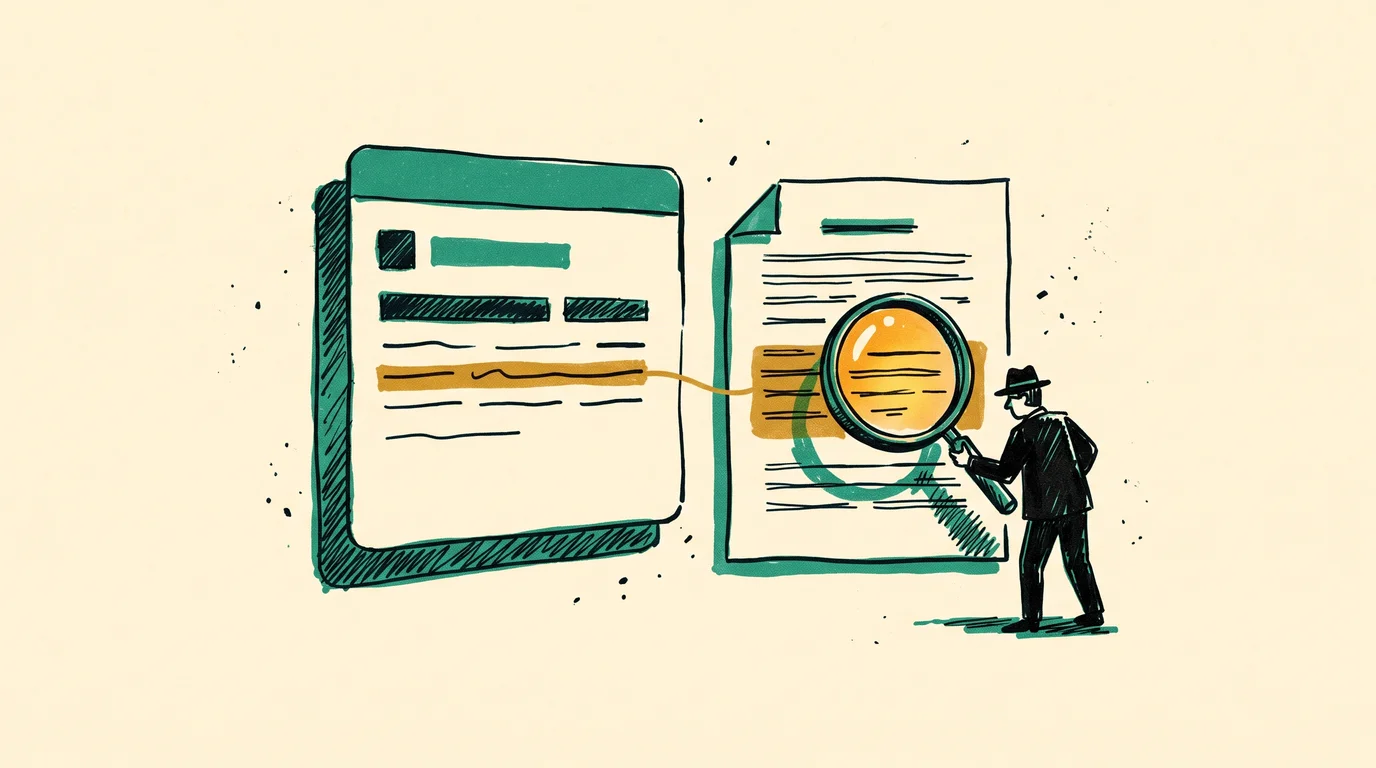
During verification, a page that repeats a fact from the answer becomes a candidate for evidence instead of a competitor to discard. Three patents on AI answers describe checking claims by retrieving documents that support them. The direction of assessment is the opposite of set selection. Agreement helps.
Retrieving evidence for a fact in the answer
Patent US20240289395A1 describes a language model with a part that generates a query and a part that generates the answer. The generated query goes to a search engine, which returns supporting resources. One of the claims provides for detecting a fact in a segment of the answer. The segment then becomes a second query. The answer receives an element leading to the top-ranked result for that query.
Entailment analysis and hallucination correction
Patent US20250094456A1 describes entailment analysis, that is, checking whether a document logically confirms a sentence. The system extracts segments from the model output and selects those suitable for checking. For each one, it formulates a query and retrieves a document. An entailment model assesses whether the document supports the segment or contradicts it. Annotations with these assessments appear next to the answer.
Patent US20260154578A1 applies the same scheme to correction. After the entailment assessment, it indicates which part of the output needs rewriting. The descriptions do not say whether a page used for verification is later shown as a source.
Agreement of many documents as background
Patent US8954412B1, from a 2006 filing, describes corroborating facts. The system creates hypothetical answers and counts the documents that support each of them. It treats a fact with the required number of supporting documents as probably correct. Against this background, repeating the consensus works in the fact's favor. The report does not settle whether copies of one original count separately. This is the weakest point of the premise.
What decides whether AI cites a specific passage of a page?
A citation probably depends on whether a passage of the page supports a specific sentence of the answer. The topical match of the whole page matters less. Two patents describe attribution as a pair: a statement and an evidence passage.
Patent CN120051770A describes retrieving evidence sources for the text of a first language model. A second model generates new text after comparing the first text with the sources. Passages from the sources are linked to the text as attribution. The goal is to determine whether a given part of the content is supported by external evidence or contradicts it.
Patent US20250156456A1 describes an answer made of one or more statements. Citations link each statement to an evidence passage in the corpus. An attribution scoring model measures how well the answer is grounded. The language model is fine-tuned to meet a threshold of that quality.
Both descriptions imply that the unit of citation is the paragraph. The page is only a wrapper. A paragraph that supports one claim on its own is easier to match to a sentence of the answer. A paragraph covering several threads requires the system to extract the right part. This is the same reason why a Google ranking and an AI citation can diverge, which we cover in GEO: will your brand disappear from search results.
The reports do not describe how the system chooses between several pages that support the same statement equally well. This is where the evidence ends. Everything beyond is inference.
Putting both stages together gives two paths into an answer. The first rewards how different a passage is from the set, meaning a new angle and your own data. The second rewards agreement with a specific claim, meaning a clearly stated established fact. A page that repeats the consensus mainly has a chance on the second path.
| Stage | What the system assesses | How repetition works | Patents |
|---|---|---|---|
| Passage selection for synthesis | Relevance and diversity of the set | A copy of chosen information probably loses its slot | US20260072965A1, US20090024606A1, US12326889B2 |
| Verification and attribution | Whether a document supports a specific sentence | The same information can serve as evidence | US20240289395A1, US20250094456A1, US20260154578A1, CN120051770A, US20250156456A1 |
| Background: deduplication and corroboration | Copies in results, number of documents supporting a fact | Analogy from other fields, unconfirmed for AI | US10007731B2, US20160232591A1, US8954412B1 |
What do the patents leave unsaid about duplicate content?
The analyzed patents describe neither a limit on passages from one domain nor a penalty for copied content. These are the two most common assumptions in discussions about duplication, and the material gives no basis for them.
No quoted claim describes a limit on the number of passages from one domain or one resource in the set for synthesis. A feature table in one of the reports does attribute to a claim the exclusion of multiple passages from the same domain. The quoted claim text does not contain this, though. Such a limit therefore remains unconfirmed.
The material also does not describe detecting syndicated content when counting documents that support a fact. It does not explain how the system resolves a situation where some sources support a passage and others contradict it. The patents on redirects and seller listings are only analogies from other fields.
The strongest counterargument to the idea that repetition strengthens a fact concerns the reach of verification. Verification may only retrieve the top-ranked document for a query built from the passage. A second page with the same content would then never be retrieved. The material does not settle this hypothesis either way.
All the documents discussed describe the scope of legal protection. A patent application does not prove that Google uses a given mechanism in AI Overviews and AI Mode. It also says nothing about the weight the described solution would carry next to other ranking signals. A patent is a possibility. Deployment is a separate question.
The conclusions of this analysis are therefore working hypotheses. Each one can be tested on your own data by tracking which paragraphs appear as a source.
What should you do with content that repeats established facts?
Content that repeats established facts is worth splitting into two layers: paragraphs with facts for verification and paragraphs with a new angle for the set. Each layer targets a different stage described in the patents. The steps below are an interpretation and go beyond what the patents claim.
Diagnosis starts with queries. The first step is choosing 10–20 queries for which the page should be a source. For each, note the aspects already covered by the cited pages. Diversity-based selection requires knowing how your own passage differs from those already chosen.
The second step concerns claims. For each page that should be a source, write a list of 3–5 claims, and give each one a paragraph that supports it on its own. In the described mechanisms, attribution links a statement to a specific passage of the page.
The third step is a duplication check, that is, checking whether the same paragraphs appear on other subpages of the site or on partner sites. The shingle patent shows that repetition can be detected at the level of word sequences.
The fact layer needs simplicity. State an established fact in one clear sentence, consistent with independent sources. Entailment analysis assesses whether a document supports a specific passage, so the sentence must be comparable with one claim.
The novelty layer needs your own contribution: your own data or an angle the cited pages lack. Answers to follow-up questions that users ask after the basic answer also help.
Measurement closes the cycle. About every 30 days, check for the selected queries which paragraphs appear as a source. Track fact paragraphs and own-data paragraphs separately, because the described paths reward different things. Whether citations turn into visits will show in GA4, provided measurement works correctly. You can check that with our GA4 Audit.
One mistake is paraphrasing an already cited source without adding a new angle. In diversity-based selection, such a passage loses to the original that is already in the set. Another mistake is diluting claims in long paragraphs that cover several threads. This is how we work with client content in our SEO and GEO service.
Q.Does Google penalize duplicate content in AI Overviews?
The analyzed patents do not describe a penalty for duplicate content in AI answers. The described passage selection favors a diverse set, so a copy probably loses its slot without being penalized. During verification, the same information can even serve as evidence. The patents do not confirm how AI Overviews work, though.
Q.Will copies of my text on partner sites strengthen a fact in an AI answer?
Unknown, because the material does not settle it. Patent US8954412B1 counts documents that support a fact, yet it does not describe how copies of one original are treated. They may count as several documents or as one. It is safer to assume that syndicating a text will not strengthen its position in AI answers.
Q.Can several similar subpages end up in one AI answer?
The material does not rule it out, yet the deduplication analogies suggest a risk. The shopping search patent limits near-identical listings from the same seller. If similar logic worked in AI, twin subpages would compete for one slot. No report describes such a mechanism for AI answers, though.
Q.Is rewriting someone else's text in your own words enough to get cited by AI?
Probably not, if the paraphrase adds no new angle. Passage selection according to patent US20260072965A1 adds the passages least similar to those already chosen. A paraphrase of the same information then loses to the original. Your chances improve when you state a fact clearly as evidence or add your own data.
More on SEO and AI search
- How Much Does SEO Cost: Pricing Guide and Red Flags to Watch For
- ChatGPT Ads: how the channel works and how to run a first test worth learning from
- GEO: Will Your Brand Disappear From Results If You Don't Optimize for AI?

Follows how AI search engines pick sources for their answers and structures client websites so that individual paragraphs can be cited.
LinkedInRelated articles
Let's talk growth
Send a brief or drop your contact. We'll reply within 24h.
Get a quote