Sales funnel: stages, metrics and ad campaigns for every stage

A sales funnel describes the customer's path from the first contact with a brand to the purchase and shows how many people drop off along the way. We split it into stages, assign ad campaigns and metrics to each one, and then show how to find the stage in GA4 where you lose the most customers. Amounts are given in PLN, as they come from the Polish market.
What is a sales funnel?
A sales funnel is a model of the customer path that splits it into consecutive stages (from noticing a brand, through comparing offers, to the purchase) and shows what share of people moves from one stage to the next. The name comes from the shape: the top holds the most people, some drop off at every stage, and customers remain at the bottom.
Funnel stages are often labelled TOFU, MOFU and BOFU: top, middle and bottom of the funnel. The top holds people who are only getting to know the brand or their problem. The middle holds people comparing solutions. The bottom holds people ready to buy or to leave their contact details.
A funnel turns the vague question "why are sales too low?" into a specific one: at which stage do customers drop off. You fix low traffic at the top with reach campaigns and abandoned carts at the bottom with changes to the store, so without that answer it is easy to spend the budget on the wrong fix.
How does a sales funnel differ from a marketing funnel?
A marketing funnel ends when you capture a contact or a first conversion, while a sales funnel continues to a signed contract or a paid order. In B2B companies these are two parts of one path: marketing owns the top and the middle, the sales team owns the bottom.
In an online store the line blurs, because the customer goes from the ad to the payment without talking to a salesperson. In e-commerce we therefore usually speak of one funnel that covers the campaigns and the purchase path on the site: the product page, the cart and the checkout.
| Feature | Marketing funnel | Sales funnel |
|---|---|---|
| End of the path | A lead or a first conversion | A signed contract or a paid order |
| Who owns it | Marketing | The sales team; in e-commerce the store and the checkout |
| Main metrics | Reach, clicks, cost per lead | Share of leads that became customers, sales value |
| Where you measure | GA4 and ad platforms | CRM, the store system, GA4 |
What are the stages of a sales funnel?
A sales funnel usually has four stages: awareness, consideration, decision and post-purchase loyalty. The number of stages is flexible: a store can split the decision into cart and checkout, and a B2B company into lead, meeting and proposal. Each stage should be measurable with a single event.
| Stage | Customer's question | Example event |
|---|---|---|
| Awareness (TOFU) | "I have a problem, what are the solutions?" | First visit, video view |
| Consideration (MOFU) | "Which offer fits me?" | Product view (view_item), pricing page visit |
| Decision (BOFU) | "Do I buy here or from a competitor?" | Add to cart, checkout start, form submission |
| Loyalty | "Will I come back for more?" | Repeat purchase, referral |
The event names in the table come from the GA4 recommended ecommerce events described in the Google Analytics developer documentation. For a store Google lists, among others, in this order: view_item_list (product list), view_item (product page), add_to_cart, view_cart, begin_checkout, add_shipping_info, add_payment_info and purchase. Each of these events can be a separate funnel stage in reports.
Which ad campaigns should you run at each funnel stage?
At the top of the funnel you run reach and video campaigns, in the middle traffic and remarketing campaigns, and at the bottom conversion campaigns: search, sales and lead form campaigns. Ad platforms name campaign objectives much like funnel stages.
In Meta Ads you choose the campaign objective from six options: awareness, traffic, engagement, leads, app promotion and sales. The Meta Marketing API documentation lists them as OUTCOME_AWARENESS, OUTCOME_TRAFFIC, OUTCOME_ENGAGEMENT, OUTCOME_LEADS, OUTCOME_APP_PROMOTION and OUTCOME_SALES. In Google Ads, Demand Gen campaigns cover the top and the middle of the funnel. Google Ads Help describes them as campaigns shown on YouTube, Discover, Gmail, Maps and the Display Network that also reach people who are not yet searching for the brand. The bottom of the funnel belongs to Search campaigns, because they answer queries from people already looking for the product.
| Stage | Google Ads | Meta Ads | What you judge |
|---|---|---|---|
| Awareness | YouTube, Demand Gen | Awareness, traffic | Reach, cost per thousand impressions (CPM), views |
| Consideration | Demand Gen, remarketing | Engagement, traffic, remarketing | Cost per visit, on-site engagement |
| Decision | Search, Performance Max, Shopping campaigns | Sales, leads | Cost per conversion, ROAS |
| Loyalty | Remarketing to customers | Sales to a customer list | Returning customers, order value |
You judge each stage by a different metric, because a top-of-funnel campaign reaches people who are only getting to know the brand. B2B cost per lead shows this: from our practice it is roughly 30–150 PLN in Meta Ads and 80–300 PLN in Google Ads Search. Meta brings cheaper contacts from an earlier funnel stage, and search brings more expensive ones that more often turn into sales.
The most common mistake is judging top-of-funnel campaigns by last-click cost per purchase. Such a campaign then looks unprofitable, even though it supplies the people who click a search ad a few days later. How to split credit for a sale between campaigns is covered in our article on attribution models.
How do you measure a sales funnel in GA4?
You measure a sales funnel in GA4 with a funnel exploration, where each stage is one event or page view and the report shows how many people moved on and how many dropped off. According to the Google Analytics Help article "[GA4] Funnel exploration", you can define up to 10 stages in one funnel. The report has four settings that help with diagnosis:
- Open or closed funnel: in a closed funnel users must enter at the first step, in an open funnel they can enter at any step. For a store you usually choose an open funnel, because some customers land straight on a product page from an ad.
- Time between steps: the "Show elapsed time" option shows the average time it takes to move from one step to the next.
- Breakdown by dimension: e.g. by device category you can check whether customers on phones drop off more often than on desktops.
- Next action: the "Next action" card shows the most common actions after a given step, e.g. the page a user went to instead of the cart.
Funnel measurement starts with events. If the store does not send add_to_cart or begin_checkout, the exploration shows an empty stage and you conclude that customers vanish, while only the measurement is missing. Mark purchases and submitted forms in GA4 as key events: Google Analytics Help defines them as events that measure actions particularly important to the business. Whether your site sends the full set of funnel events, you can check in the free GA4 Audit.
We configure events, key events and funnel reports as part of our GA4 implementation service.
How do you find the stage where the funnel loses customers?
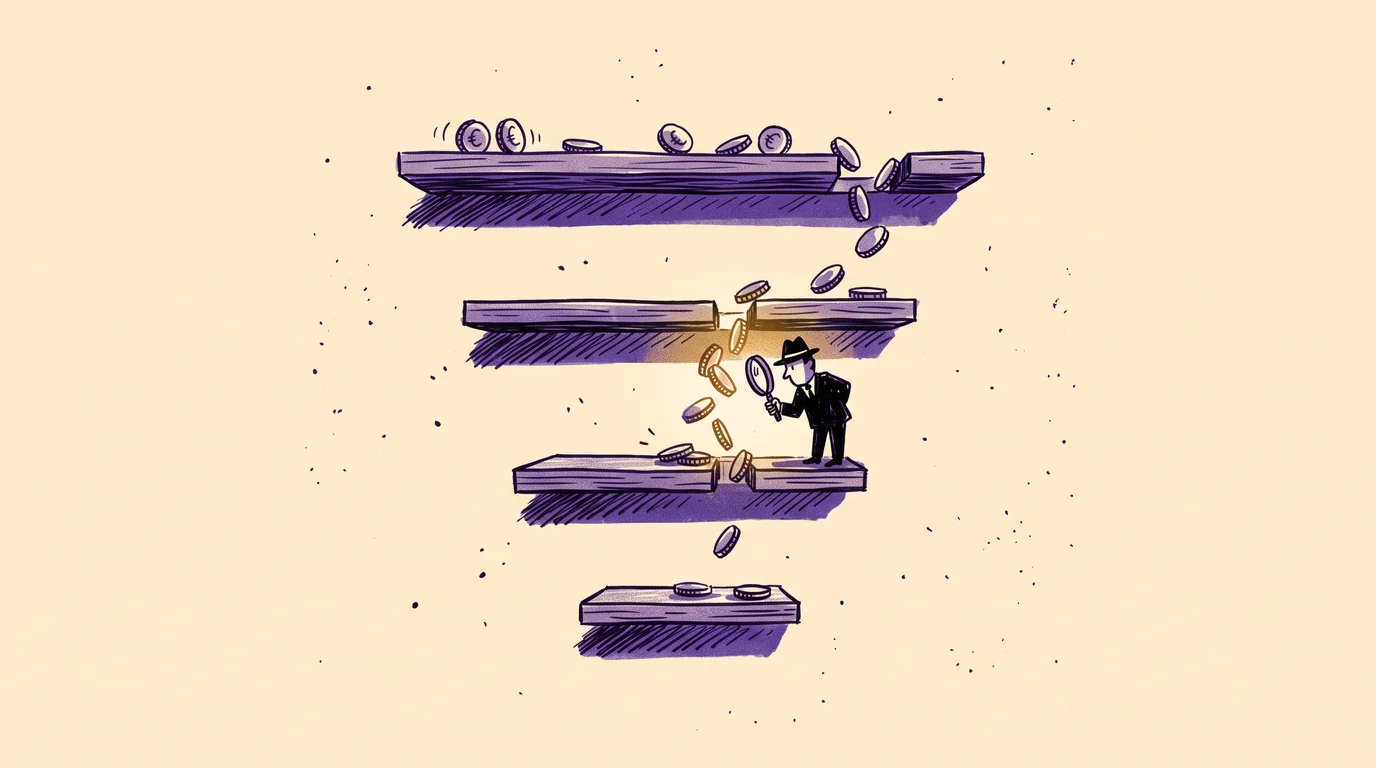
You find the stage where the funnel loses customers by calculating the progression rate between each pair of neighbouring stages, i.e. what percentage of people from the stage above reached the stage below. You compare each rate with the previous period: a rate that dropped points to the place to fix, and a fix at the bottom of the funnel increases sales on the same ad budget.
Compare progression over time and between segments, e.g. devices or traffic sources. General averages from the internet say little about your store, because progression rates depend on the industry, the price and the type of product.
Each stage has typical causes of loss:
- Few people at the top of the funnel: campaign reach that is too small or audiences that are too narrow.
- Visits without a product view: the ad promises something different from the page it leads to.
- Product page without add-to-carts: price, photos, description or missing delivery details. The free UX Audit points out such problems.
- Abandoned carts and checkouts: extra costs shown only at checkout, forced account creation, few payment methods.
- Leads that never become customers: lead quality or sales follow-up, a problem you cannot see in the ad platform.
An example from our work: in the O2 Trainer case study Meta Ads campaigns brought plenty of clicks, yet only 0.67% of them ended in a purchase. The problem sat after the click, so instead of raising the budget we rebuilt the landing page in four iterations. Click-to-purchase conversion rose to 4.03% and cost per purchase fell by 77%.
What does a B2B sales funnel look like?
A B2B sales funnel is longer than a store's, because between the first contact and a signed contract there are a lead, a sales call and a proposal, and several people make the decision. The bottom of a B2B funnel happens off the site (in the CRM, in email and in meetings), so the ad platform sees only the leads.
To make campaigns learn from customers instead of forms, send sales results from the CRM back to Google Ads. According to the Google Ads Help article "About offline conversion imports", you store the GCLID click identifier with the lead's details, and when the lead signs a contract you upload that identifier to Google Ads as a conversion. We describe the full setup in our article on offline conversions.
A long funnel also needs a different order of messages. In the Verestro case study the LinkedIn contact form was opened about 1,000 times and produced 14 leads, because the audience was only getting to know the brand. After changing the order (brand and reach campaigns first, the form shown only to people who had already engaged with the brand) form conversion rose from 1.4% to 8.5% and cost per lead fell from 3,603 PLN to 1,536 PLN.
We run campaigns for companies with long sales cycles as part of our LinkedIn Ads service.
How do you build a sales funnel step by step?
You build a sales funnel backwards: first you define what a conversion means for the business, then the stages that lead to it, and finally the campaigns for each stage. Without measured stages you can judge campaigns only by clicks, which is why measurement comes before campaigns.
- Final conversion: a purchase, a signed contract or a booked meeting, i.e. the event the business gets paid for.
- Stages and events: a handful of stages, each mapped to one GA4 event or CRM status.
- Measurement: on-site events, key events in GA4 and sales data passed from the CRM to ad platforms.
- Campaigns per stage: reach and video at the top, remarketing in the middle, search and sales at the bottom, each judged by its own metric.
- Monthly review: comparing progression between stages with the previous period and fixing the one that dropped.
How much you can pay for a bottom-of-funnel conversion and stay profitable follows from your margin: we show the formula in our article on break-even ROAS. What a full funnel looks like on an e-commerce account at the peak of the season is covered in our piece on Black Friday and Cyber Monday campaigns.
For a wider view of campaigns paid for results, read our guide performance marketing: what it is and how it works. As a marketing agency we run Google Ads and Meta Ads campaigns across all funnel stages, together with measurement that shows where customers drop off.
Q.Does a sales funnel require a CRM?
Not in an online store, because the whole path from the ad to the payment happens on the site and you measure it in GA4. A service business or a B2B company needs a CRM, because only there can you see which leads became customers. Without a CRM you judge campaigns by the number of forms.
Q.Which funnel stage should you start with on a small budget?
The bottom of the funnel, i.e. search and remarketing campaigns, because they reach the people closest to buying. From our practice the minimum test budget is from 4,000 PLN per month per channel, and two channels at once start from 8,000 PLN in total. You add the top of the funnel once the bottom starts bringing sales.
Q.Is a customer journey the same thing as a sales funnel?
No. A customer journey describes every contact with a brand in any order, including returns and jumps between channels. A funnel simplifies it to a few stages in a fixed order, so you can count how many people move on. You analyse the journey in attribution reports and the funnel in a funnel exploration.
What sources is this article based on?
The names and order of ecommerce events come from the Google Analytics developer documentation (recommended ecommerce events in GA4). The description of funnel explorations and key events comes from Google Analytics Help: "[GA4] Funnel exploration" and "About key events". Meta campaign objectives are described in the Meta Marketing API documentation (campaign object, objective field), Demand Gen campaigns in the Google Ads Help article "About Demand Gen campaigns", and offline conversion imports in the article "About offline conversion imports". Lead costs and budgets are indicative ranges from our practice, and campaign results come from our O2 Trainer and Verestro case studies.
More on Performance marketing and budgets
- Performance Marketing: What It Is, How It Works, and What It Costs
- Running a full-funnel e-commerce account through BFCM week
- PPC (Pay-Per-Click): what it is, what it costs, and when it pays off
- Best e-commerce agencies in Poland — 2026 ranking
- Break-even ROAS and maximum CPC: how much you can really pay per click
- Best marketing agencies in Poland — 2026 ranking
- Best performance marketing agencies in Poland — 2026 ranking
- How Much Should You Spend on Google Ads and Meta Ads in 2026?
- 7 Signs Your Marketing Agency Is Burning Your Budget

Before he raises a campaign budget, he maps the client's funnel into stages and checks where most people drop off. More often than in the ad, the problem sits in the cart or in how leads are handled.
LinkedInRelated articles
Let's talk growth
Send a brief or drop your contact. We'll reply within 24h.
Get a quote