Performance Max vs Search: Which Google Ads Campaign Sells More

Performance Max and Search campaigns in Google Ads solve different problems, so "which one should I pick" usually has the wrong answer built in: a single campaign type. Search gives you full control over keywords, ad copy, and exclusions -- you see every query your ad matched. Performance Max automatically tests channels (Search, Shopping, YouTube, Display, Gmail, Discover) based on your product feed and conversion signals, but takes away visibility into specific queries. Stores with a clean feed and a steady conversion volume usually gain from PMax; smaller budgets, B2B sales, or a fresh account do better starting with Search.
How Performance Max Differs From Search
A Search campaign runs on keywords you pick and exclude yourself -- you see the search terms report, control every ad group, and can turn off a keyword the moment it stops converting. Performance Max shows no search terms report and no channel-level budget breakdown: you supply assets (copy, images, video, product feed) and a conversion goal, and Google's system decides who sees the ad, where, and on which channel.
That difference shapes the data you get back. In Search you know exactly which keyword your budget went to. In PMax you see an aggregated result for the whole campaign -- Google only exposes a limited view of search categories (insights), never the full list of queries.
When to Start With Search
Search works best as a first step when you're still building conversion history on the account, selling B2B with a long decision cycle, or working with a budget too small for the PMax algorithm to learn from. A Search campaign also gives you full control over which queries you spend money on at all -- crucial when a single lead is worth a lot.
- A fresh account with no conversion history -- Search lets you build data step by step while watching the search terms report
- B2B or service sales with a small number of high-value leads -- keyword control matters more than reach here
- Monthly budget below the threshold where PMax can gather enough data for meaningful automation (see below)
- A brand with low awareness -- without a dedicated brand campaign, PMax has no high-intent signal to build on anyway
When It's Worth Adding Performance Max
Performance Max works best for product sales with a clean feed (Google Merchant Center) and a steady conversion volume -- Google recommends a minimum of roughly 30 conversions per campaign over 30 days for the algorithm to have something to learn from; below that threshold the system optimizes on random noise, not a real signal.
An Optmyzr study of 24,702 campaigns across 9,199 accounts found more than half of advertisers (51%) put over half their Google Ads budget into PMax, and 82% run it alongside other campaign types, not instead of them. One detail from the same study: 55% of accounts run PMax without a connected product feed -- meaning no access to Shopping, the strongest channel this campaign type has for ecommerce.
How Much Conversion Rate and CPA Actually Differ
Search campaigns typically post a higher conversion rate than PMax, because they catch the moment a user types in a high-purchase-intent query themselves -- industry benchmarks show a gap of roughly 3-3.5% for Search versus 1.5-2.5% for PMax. PMax makes up for it with a lower cost per acquisition: access to Shopping and Display remarketing can push CPA 15-25% below Search alone, at the cost of losing visibility into which queries actually sell.
| Criterion | Search | Performance Max |
|---|---|---|
| Keyword control | Full -- you see and exclude every query | None -- only a limited view of categories (insights) |
| Channels | Search only | Search, Shopping, YouTube, Display, Gmail, Discover |
| Typical CVR | Higher -- catches high purchase intent | Lower in aggregate -- blends traffic of mixed intent |
| Typical CPA | Higher at the same volume | Usually lower thanks to Shopping and remarketing |
| Minimum data needed | Works from day one | Needs roughly 30 conversions/30 days to learn well |
Where AI Max Fits Into This
There's a third piece to the picture: AI Max for Search, an AI feature layer added on top of a regular Search campaign -- automatic keyword expansion, ad copy variations, and landing page matching generated on the fly. It's still a Search campaign, not a separate type like PMax, just with more automation built in. Google reports that the full AI Max feature set delivers an average of 7% more conversions at a similar CPA compared to keyword matching alone. Starting September 2026, Google is automatically migrating campaign-level broad match Search campaigns to AI Max -- if you run Search, it's worth checking your account for that notice before the migration overwrites your current setup without asking.
Why PMax and Search Overlap -- and What to Do About It
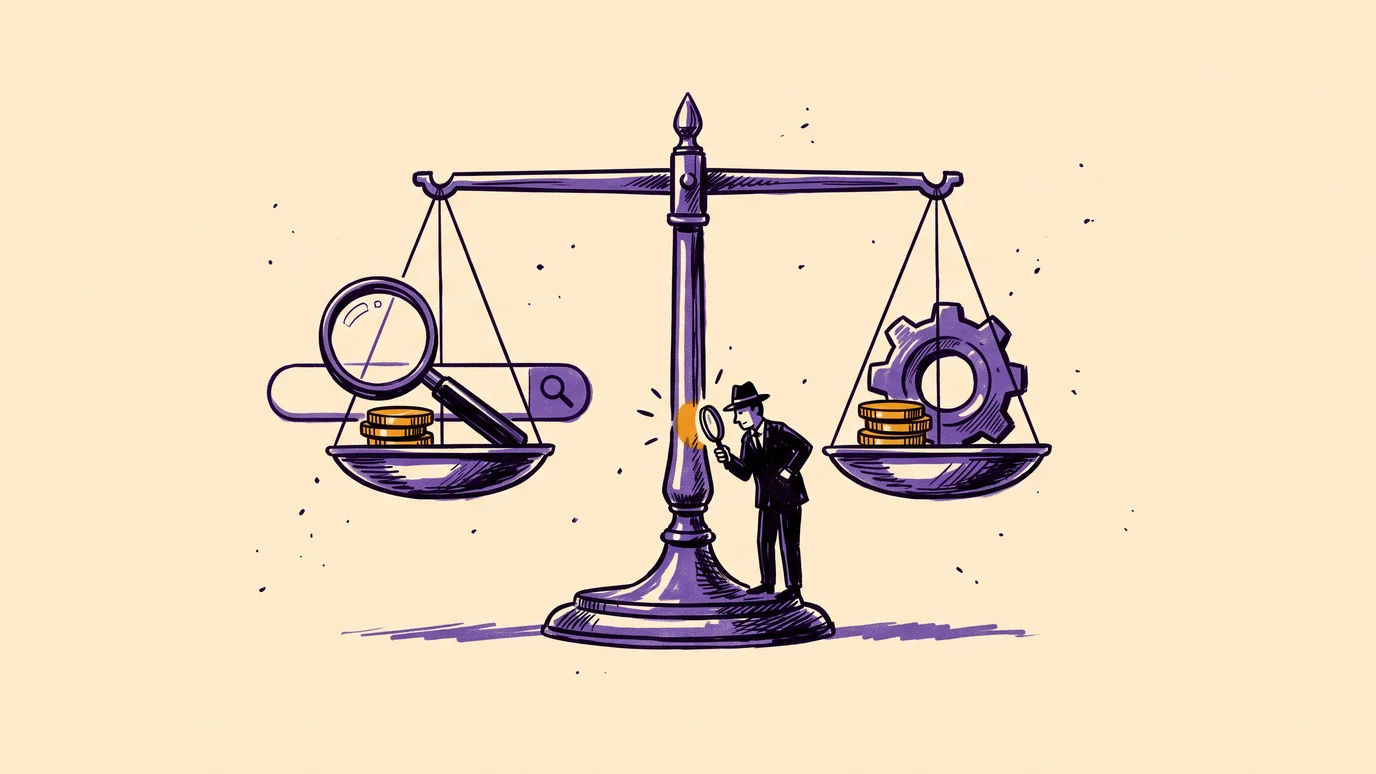
Performance Max doesn't separate branded traffic from new-customer traffic in its reporting, so it happily scoops up queries containing your company name that would have converted anyway -- we cover the mechanics of this ROAS-inflation effect in more depth in Performance Max and inflated ROAS. The fix is technically simple, if it takes a one-time setup: a brand exclusion list in the PMax campaign (available at the account level) plus a dedicated Search campaign for brand terms that PMax can't take over.
Without that setup, budget circulates between two campaigns competing for the same, already-decided customer instead of reaching new ones -- and the dashboard shows a better result than what's actually happening.
How to Safely Run Both Campaigns Together
A sensible order for most accounts: 2-6 weeks of Search alone on high-intent terms, to gather conversion data and clean up the exclusion list, then add PMax with the brand list carved out of the automation. Feeding both campaigns the same product feed and the same conversion goals makes results easier to compare and avoids duplicating data work.
- Keep brand in its own Search campaign, and exclude it from PMax with an account-level brand list
- Feed both campaigns the same conversion tracking -- otherwise comparing results doesn't mean anything
- Check PMax insights every 1-2 weeks instead of a search terms report -- it's the only visibility you get
- Don't turn off Search once PMax is running "to save budget" -- market data shows combining both typically delivers 10-20% higher combined ROAS than PMax alone
How Much Budget Makes This Worth It
Before turning on PMax alongside Search, check whether your budget can even reach the roughly 30 monthly conversions per campaign it needs. At a cost per conversion of $15-40, typical for a mid-size ecommerce store, that means a realistic minimum of $450-1,200 a month on the PMax campaign alone -- below that threshold, further optimizing Search alone is the more effective move. We break down how to calculate the maximum profitable cost per click in our piece on break-even ROAS and max CPC.
The choice between Performance Max and Search is rarely final -- accounts grow, feeds change, and what didn't make sense at 20 monthly conversions can work at 100. At Zest, as a digital marketing agency we run both campaigns on the client's own account, with a brand exclusion list set up from day one and a report that separates PMax's result from what would have sold anyway. If you're wondering whether your account is ready for PMax, let's talk about running your Google Ads campaigns.
FAQ
Q.Performance Max or Search -- which should a new account run first?
Search -- it lets you gather conversion data and build account history from day one, without risking PMax's algorithm learning from too small a sample. Add PMax once the account has a steady conversion volume, ideally with a product feed connected.
Q.Does Performance Max replace a Search campaign?
It shouldn't. Optmyzr's study found 82% of advertisers run PMax alongside other campaign types, not instead of them. Brand performs best in its own Search campaign excluded from PMax, to avoid PMax scooping up traffic that would have converted anyway.
Q.How many conversions does Performance Max need to perform well?
Google recommends roughly 30 conversions per campaign over 30 days as a minimum for the algorithm to learn from. Below that, PMax optimizes on too small a data sample, often performing worse than a well-structured Search campaign.
Q.Why does Performance Max show a higher ROAS than Search?
Because PMax's reporting doesn't separate branded traffic from new-customer acquisition, and it readily claims conversions from queries containing your company name that would have happened anyway. A brand exclusion list and a dedicated Search brand campaign show how much of that result is real incremental growth.
Q.Can you run Performance Max without a product feed?
Technically yes, but you lose access to Shopping -- PMax's strongest channel for product sales. Optmyzr's study found 55% of accounts run PMax without a connected feed, which in practice limits the campaign to a weaker version of Display and YouTube.

Runs Google Ads accounts where Performance Max and Search don't compete for the same customer but split the work -- brand always sits in its own Search campaign, excluded from PMax automation.
Related articles
Let's talk growth
Send a brief or drop your contact — we'll reply within 24h.
Get a quote