Anchor text
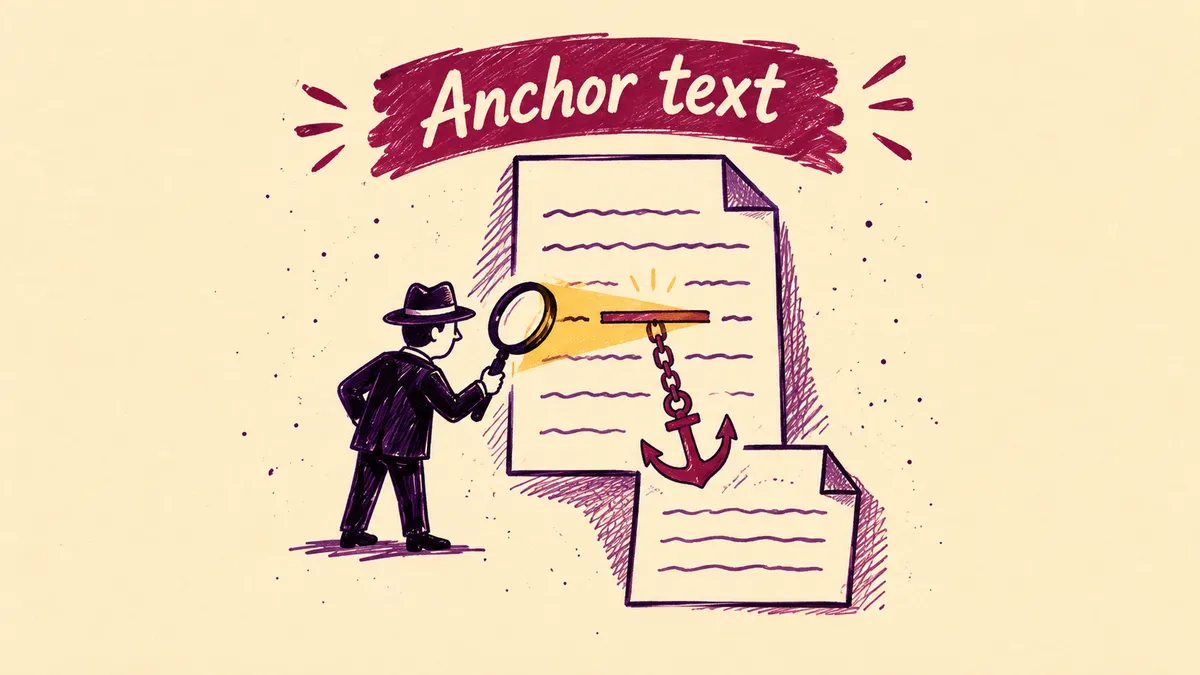
Anchor text (also: link text, anchor) is the visible, clickable text of a link on a web page. In HTML it sits between the <a> and </a> tags. According to Google Search Central, anchor text tells users and Google what the target page is about. It is therefore one of the signals that help a search engine understand the content of the linked page.
Example: in the markup <a href="/en/glossary/seo-audit">SEO audit</a>, the anchor text is the phrase “SEO audit”.
How does Google use anchor text?
Google treats anchor text as a description of the page the link leads to. Google's link best practices documentation stresses that the better the anchor text, the easier it is for people to navigate the site. It also makes it easier for Google to understand the topic of the target page. The condition is that the text sits in an <a> element with an href attribute that crawlers can read.
When a link has no text
Google provides two fallback sources of anchor text. If the <a> element is empty, the search engine may fall back on the title attribute. For an image link, the alt attribute of the img element becomes the anchor text. That is why image links should have descriptive alternative text.
Text inserted by JavaScript
Anchor text can be inserted by a script, e.g. in menus or widgets. Google then recommends checking whether the text appears in the rendered HTML. The URL Inspection tool in Google Search Console is used for this.
What are the types of anchor text?
In SEO practice, anchor text is divided into several types depending on how it relates to the target page's keyword. This is an industry classification, not Google's. It still helps assess a link profile during an SEO audit.
| Type | Description | Example for a page about SEO audits |
|---|---|---|
| Exact match | The exact keyword of the target page | SEO audit |
| Partial match | The keyword with additional words | what an SEO audit of a store looks like |
| Branded | The brand name | Zest |
| Naked URL | The page address itself | zest.agency/en/glossary/seo-audit |
| Generic | Text with no information about the target | click here, more |
| Image | The alt attribute of an image used as a link | the image's alternative text |
Good and bad anchor text according to Google
According to Google, good anchor text is descriptive, reasonably concise and relevant to both pages. It gives context and sets the reader's expectations. Google lists three typical mistakes:
- text that is too generic, e.g. “Click here” or “Read more”;
- unnaturally long text that covers a whole sentence;
- several links placed one after another with no text around them.
The surroundings of a link matter too. Google notes that the words before and after a link also build its context. That is why an anchor is best placed in a full, natural sentence.
When does anchor text violate Google's policies?
Anchor text violates Google's policies when its main purpose is to manipulate rankings rather than describe the target page. Google's spam policies (updated 28 August 2026) define link spam as creating links mainly to manipulate rankings. Several examples from that list concern anchor text directly.
- links with optimized anchor text in articles, guest posts or press releases published on other sites;
- keyword-rich, hidden or low-quality links in widgets distributed across many sites;
- widely distributed links in the footers or templates of various sites;
- forum comments with optimized links in the post or signature.
Keyword stuffing in links
Google's link documentation also warns against stuffing an anchor with every keyword related to the target page. According to Google, keyword stuffing means filling a page with keywords to manipulate results. Such words often appear in lists, unnaturally or out of context. Google suggests a simple check: does the reader need these words to understand the next page?
Another practice that violates Google's policies is described in the parasite SEO entry. In internal linking, the safest approach is natural, varied anchors that actually describe the target of the link.
Frequently asked questions
Q.What is anchor text?
Anchor text is the visible, clickable text of a link. In HTML it sits between the <a> and </a> tags. Google uses it to understand what the target page is about. For users, it hints where the link leads before they click it.
Q.Does a “click here” anchor hurt SEO?
A “click here” anchor does not violate Google's policies, but it carries no information about the target page. Google lists such text as an example of anchors that are too generic. It is better to use a phrase that describes the content of the linked page. This helps both readers and the search engine.
Q.Can you use exact match anchors?
Yes, in natural internal linking a phrase that describes the page exactly is often the best anchor. The problem is optimized anchors in links created for rankings. Google's policies list, among others, such links in sponsored articles, guest posts and press releases. In that case they may be treated as link spam.
Q.What does Google do when a link has no text?
When an <a> element is empty, Google may fall back on the title attribute as anchor text. For image links, the alt attribute becomes the anchor text. Without either of them, the link has no description. That is why image links always need descriptive alternative text.
Let's talk growth
Send a brief or drop your contact. We'll reply within 24h.
Get a quote