Agentic Commerce Funnel: how the sales funnel is changing in the era of autonomous AI agents

An Agentic Commerce Funnel is a sales funnel in which discovery, comparison and increasingly also the purchase are taken over by an AI agent acting on the customer's behalf. Instead of browsing search results and store pages, the customer delegates a task and the agent returns a shortlist of offers. According to BCG (2026), 96% of AI-assisted shoppers use AI at the product discovery stage. Only 4% would let an agent complete a purchase on its own. The funnel does not disappear, it shrinks, and visibility depends on whether a machine can read and verify the offer.
What is agentic commerce and how fast is it growing?
Agentic commerce means purchases carried out by AI agents acting on the user's behalf. McKinsey (October 2025) describes agents that anticipate needs, compare options, negotiate and complete transactions in line with the customer's intent. According to the same analysis, by 2030 agents could handle USD 3 to 5 trillion in global goods commerce revenue. In US B2C retail alone, that is around USD 0.9-1 trillion.
Three agent interaction models
McKinsey distinguishes three ways in which an agent interacts with a seller:
- agent to site: the agent uses the store's platform itself, e.g. compares hotels and books a room;
- agent to agent: the customer's agent negotiates with the seller's agent, e.g. a discount on a bundle;
- brokered agent: an intermediary system coordinates the work of many agents and platforms.
Tinuiti (June 2026) adds a scale of autonomy. An assistive agent only compares and recommends. A semi-autonomous agent buys within rules set by the user, e.g. a budget limit. A fully delegated agent completes the whole task with minimal human involvement.
What does it look like in Europe and Poland?
The Deloitte report prepared for Google covered 13,500 consumers from 15 European markets, surveyed in May 2026. Poland ranks second: 63% of respondents used AI when shopping, behind only Spain (67%). At the same time, 45% of Poles would not let AI make a purchase decision for them. A hybrid purchase path combining AI and traditional channels is chosen by 62% of respondents in Poland.
How does the agentic funnel differ from the classic sales funnel?
The agentic funnel differs from the classic one in that its stages take place inside a conversation with the agent rather than on the brand's pages. In the TOFU, MOFU and BOFU model, the brand guides the customer from first contact, through consideration, to purchase. In the agentic funnel, the agent gathers information, compares offers and presents a shortlist itself. BCG (October 2026) notes that discovery and purchase are still separate, but the funnel is compressing.
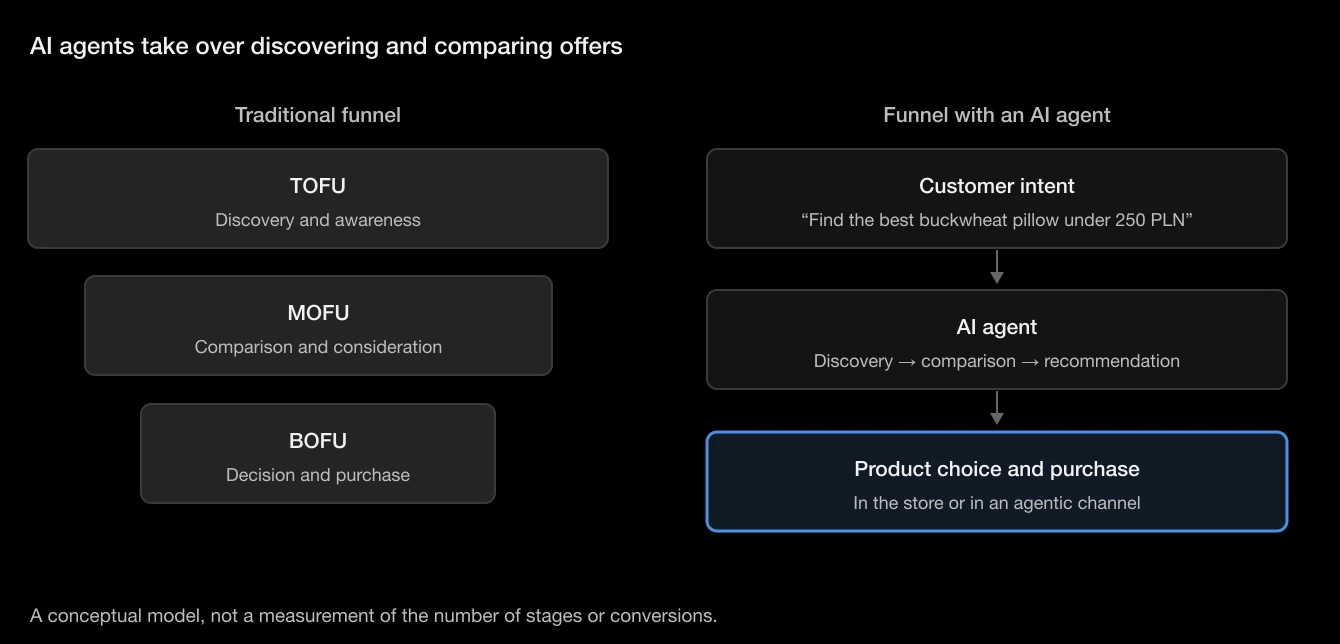
In the traditional funnel, customers move through the stages themselves, and the brand accompanies them at each one. In the agent funnel, the customer states an intent, e.g. “find the best buckwheat pillow under 250 PLN”. The agent handles discovery, comparison and recommendation, and the brand comes back into play only at the choice and purchase. That is why whether an offer makes the agent's shortlist depends on data rather than on the path through the site.
| Stage according to BCG | What the agent changes | Share of AI shoppers using AI at this stage [%] |
|---|---|---|
| Discovery | Recommendations from a language model instead of search and social media | 96 |
| Consideration | Structured comparisons of many brands, fewer impulse purchases | 80 |
| Purchase | Gradual merging of discovery and purchase into a single interaction | 24 |
| Post-purchase | Customer service and automatic reorders | no data |
The funnel as a product of probabilities
TMLS AI Research (September 2026) proposes a four-stage model: discovery, inclusion in the consideration set, selection and settlement. A product has to pass each of them, and the chance of purchase is the product of the probabilities of all stages. At the discovery stage, the product must get into the feed or index the agent searches at all. At the settlement stage, the agent must verify the terms it agrees to, e.g. price and availability.
This is an analytical model rather than an experimental result. The authors calibrate it on published benchmarks and describe their assumptions. Its conclusion is practical, though: a weak link at one stage lowers the chance of a sale across the whole funnel.
Six stages of the path according to Deloitte
The Deloitte report for Google divides the path into six stages: inspiration, research, comparison, purchase, decision and after-sales service. Social media still dominates the inspiration stage, and Google Search dominates research. In research and comparison, AI tools reach a level close to Google. The purchase itself is still controlled by traditional channels.
How does an AI agent choose an offer?
An AI agent chooses an offer based on the data it can read and compare, rather than on how the page looks. BCG reports that around 70% of AI shoppers compare product attributes and around 50% compare prices. The agent does this faster and across more offers than a person. A product whose specifications cannot be read drops out of the comparison.
Machine-readable data
The TMLS model shows well why structured data matters so much. If an agent has to read 8 attributes and reads each with a reliability of 0.97, the chance of the product being included in the comparison is about 0.78. The authors attribute this reliability to a structured feed. At a reliability of 0.75, typical for a rendered page, that chance drops to about 0.10.
The same paper cites Adobe data on traffic from AI agents in US retail. In the first quarter of 2026 it grew by 393% year over year and converted about 60% better than other traffic. That is why product descriptions are worth supplementing with Schema.org markup and complete attributes in the feed. Every product page should state specifications directly in the text, in addition to the images.
Agent bias
Agents do not choose in a fully neutral way. Allouah et al. (2025) studied agent purchases on a test marketplace. Different language models made very different decisions and often concentrated on a narrow group of products. They also showed strong position bias and reacted inconsistently to sponsored labels.
Zhao and Kang (Asia Pacific Journal of Marketing and Logistics, 2026) describe the consequences for sellers in a theoretical model. A seller invests separately in platform visibility and in agent readiness. When the platform's and the agent's rankings diverge, these two investments can compete with each other. The authors also point out that agent purchases lower prices when comparison pressure outweighs verified differentiation of the offer.
Which protocols support the agentic funnel?
The agentic funnel relies on open protocols that define how an agent talks to the store, to other agents and to the payment system. Tinuiti describes three layers of this ecosystem. The agent layer captures the customer's intent and constraints. The merchant layer exposes the catalog, prices, stock and delivery terms through APIs and feeds. The payment layer handles permissions, tokenization, settlement and returns.
| Protocol | Creator | What it is for |
|---|---|---|
| MCP (Model Context Protocol) | Anthropic | Exchanging context and data between agents, models and tools |
| A2A (Agent-to-Agent) | vendor-neutral standard | Coordination and negotiation between agents |
| AP2 (Agent Payments Protocol) | Verifiable agent payments based on signed mandates | |
| ACP (Agentic Commerce Protocol) | OpenAI and Stripe | Buying without leaving the chat, communication between agents and merchants |
| UCP (Universal Commerce Protocol) | Purchases by Gemini agents, integration with Google Pay and Merchant Center |
Who supports these standards?
According to McKinsey, AP2 is backed by Mastercard, PayPal, American Express, Adobe and Alibaba, among others. Tinuiti reports that in April 2026 Amazon, Meta, Microsoft, Salesforce and Stripe joined the UCP technical council. UCP's founders were Google, Shopify, Etsy, Target and Wayfair. For stores using Google Merchant Center, this means the product feed becomes a direct entry point to agentic purchases.
The IAB Polska Strategic Report 2026 states that AP2 and UCP enable standardized agent integration across the entire purchase path. The report also notes that in the US you can already buy products from Etsy or Wayfair in AI Mode.
What does the agentic funnel change in analytics and attribution?
The agentic funnel takes away the seller's view of the upper part of the path, because discovery and comparison happen inside the agent. MetaRouter describes how indirect purchases through an agent give the store little pre-purchase data. Attribution, personalization and campaign optimization suffer as a result. Classic analytics based on tracking browser visits does not see the conversation in which the decision was made.
Server-side data
MetaRouter points to the direction of the solution: server-side data collection and identity resolution. This lets agent interactions flow into existing optimization tools. The authors also stress the importance of high-quality product data. A free GA4 audit will show whether the current measurement in your store collects data correctly.
BCG shows the other side of the problem. 32% of retailers give direct data access only to selected agents. Meanwhile, 87% share no customer data with agents at all. McKinsey advises companies to be able to tell helpful agents from harmful bots. It also recommends reducing dependence on advertising revenue, which agent purchases may bypass.
Search traffic versus traffic from language models
BCG reports that in 2024 organic traffic fell by 10%, while traffic from language models grew by 87%. According to this analysis, AI traffic could overtake US organic search traffic as early as 2028. One global consumer goods manufacturer estimated that 20-30% of its online revenue could be at risk. Reports that show only browser channels will therefore be increasingly incomplete. We build a store's visibility in search and in language model answers as part of our SEO service.
How to prepare a store for the agentic funnel?
Preparing a store for the agentic funnel starts with product data and ends with transactional infrastructure. Tinuiti put it briefly: in the world of agents, the product catalog becomes the ad unit. BCG describes three actions brands should pursue in parallel. Pilots of optimization for generative search engines delivered 1-5% additional revenue. Own agents and ecosystem integrations delivered 3-10% growth.
- Completing feeds and structured data with all the attributes customers compare.
- Publishing prices and promotions in a structured form, updated in real time.
- Building modular APIs through which an agent can find a product, verify the user and place an order.
- Implementing server-side data collection to track purchases from agentic channels.
- Separating helpful agents from harmful bots in the store's security settings.
- Avoiding dependence on a single AI platform in favor of a modular strategy.
Bundles, prices and trust
BCG advises building links between products of the same brand so that the agent recommends whole bundles. This carries cross-selling into the world of agents. The credibility of product claims also matters. The TMLS model assumes that the agent evaluates attributes it cannot read pessimistically, so a good product loses the most.
Polish customers still prefer to hand agents simple tasks rather than the purchase itself. In the Deloitte study, 35% of respondents in Poland would entrust AI with finding the best price, and 30% with comparing products. To start, a store should therefore make sure it wins at the comparison stage. We describe broader uses of artificial intelligence in a store in our article on AI in e-commerce.
Frequently asked questions
Q.Are AI agents already buying on behalf of customers?
Partly yes, but most shoppers still complete the purchase themselves. According to BCG, only 4% of AI shoppers would let an agent finish a purchase on its own. In Europe, according to Deloitte, 8% of respondents would entrust AI with checkout and payment. For now, agents dominate the discovery and comparison stages.
Q.Will classic SEO stop mattering?
Not right away, but its role is changing. McKinsey estimates that traditional SEO may gradually lose importance in favor of metadata in product catalogs. BCG reports that AI traffic could overtake US organic traffic as early as 2028. Search visibility and readability for agents therefore need to be developed in parallel.
Q.How do the ACP and UCP protocols differ?
ACP was developed by OpenAI and Stripe, and UCP by Google; both describe communication between agents and merchants. ACP lets users buy without leaving the ChatGPT chat. UCP serves Gemini agents and connects to Google Pay and Merchant Center. In 2026, Amazon, Meta and Microsoft, among others, joined the UCP technical council.
Q.Where should a store start its preparation?
Ideally with complete and up-to-date product data in the feed and in structured data. The TMLS model shows that with eight required attributes, a feed gives about a 0.78 chance of being included in the comparison. A rendered page gives only about 0.10. The next steps are APIs for agents and server-side data collection.
More on SEO and AI search
- 12 internal linking patterns that change SEO more than one more link in the text
- ChatGPT Business Hub insights: mentions, website clicks and discovery topics
- AI in e-commerce: how an online store can benefit from artificial intelligence and AI recommendations
- Google AI Overviews in practice: the mechanism, decision gates and an action plan
- New Google materials for SEO: search traffic, CDN and “things to do”
- How to increase your brand's visibility in ChatGPT and Google AI Overview
- Google Lighthouse update changes how PageSpeed Insights simulates loading
- AI Search: how AI-powered search works
- AI hallucinations: causes and safeguards
- Duplicate content and AI citations: what Google patents say
- How Much Does SEO Cost: Pricing Guide and Red Flags to Watch For
- ChatGPT Ads: how the channel works and how to run a first test worth learning from
- GEO: Will Your Brand Disappear From Results If You Don't Optimize for AI?

When preparing a store for purchases made by AI agents, Karol starts with the product feed and checks which attributes customers compare are empty there. Measuring traffic from language models comes next.
LinkedInRelated articles
Let's talk growth
Send a brief or drop your contact. We'll reply within 24h.
Get a quote