Where does AI get its knowledge about brands?

AI gets its knowledge about brands from external sources on the web: review sites, rankings on industry portals, forums and the brand's own website. The model has no opinion of its own about a company. It summarises what it found on the cited pages. In Szymon Parzych's study, the brand's website appeared in 51-73% of AI answers. That is enough for the model to describe the brand, but rarely enough for it to name the brand as the first choice. That is decided mainly by rankings and reviews on other people's sites.
The data in this article comes from Szymon Parzych's report “Jak cię widzą, tak cię piszą” (2026). The study covered 8 brands from different industries and 966 unique questions. Each question was asked 5 times in 6 systems: ChatGPT, Gemini, Perplexity, Copilot, Google AI Mode and AI Overview. The chat interface was queried in a clean session with no conversation history, rather than the API. In total, 73,000 AI answers, 176,000 brand ratings and 954,000 source citations were collected. Brands were rated on a scale from -5 to +5.
Key findings at a glance
| AI answer study metric | Value |
|---|---|
| Share of AI answers in which the brand's website appears [%] | 51-73 |
| Share of the brand's website among unique sources [%] | 11-24 |
| Answers based solely on brand websites [%] | 4-11 |
| Typical number of unique domains per answer | 4 |
| Domains present in all 5 repetitions of a question [%] | 23 |
| Domains present in only 1 of 5 repetitions [%] | 42 |
| Share of 35 out of 10,471 domains in all citations [%] | 42 |
| Analyses in which AI cites only 1 URL from a given domain [%] | 62.3 |
| Mention frequency: studied brand / competitor [%] | 71 / 72 |
| Named as first choice: studied brand / competitor [%] | 20 / 44 |
| AI-cited rankings in which the competitor ranked higher | 11 of 14 |
| Sentiment of price mentions: brand / competitors | +0.31 / +1.94 |
| Price mentions with a negative tone [%] | 32 |
| Measurable AI traffic relative to organic traffic (fashion store) [%] | 1.7 |
How does AI search for information about brands?
AI assistants search the web for information about brands while generating an answer and list the sources they used. The OpenAI Help Center says ChatGPT searches the web on its own when a question can benefit from it. Queries may go to third-party search providers such as Bing, and answers include citations. Google describes AI Overviews and AI Mode as issuing multiple related searches across subtopics and different data sources.
Google also points out that appearing in AI features requires no additional requirements or special optimisation. A page has to be indexed and eligible to be shown with a snippet. In practice, this means a brand's image is shaped by the same pages that the search engine finds for customers' questions.
How many and which sources does AI use in an answer about a brand?
In an answer about a brand, AI usually draws on several sources at once. In Szymon Parzych's study, 9 out of 10 answers about a brand cited at least two sources. A typical answer cited 4 unique domains.
| Number of cited sources | Share of answers [%] |
|---|---|
| No sources | 3.8 |
| 1 source | 7.1 |
| 2-4 sources | 48.2 |
| 5-9 sources | 32.6 |
| 10 or more | 8.2 |
The brand's own website made up only 11-24% of unique sources in answers about that brand. The small store had the highest share (23.8%) and the manufacturer the lowest (11.3%). At the same time, between 4 and 11% of answers relied solely on the studied brands' websites. The model took the rest of its knowledge from other domains.
Which pages does AI cite besides the brand's website?
Review sites produced the most citations outside the studied brands' domains. Second place went to pages of other companies in the industry, which often means competitors.
| Source type | Share of citations outside brand domains [%] |
|---|---|
| Review sites | 26.6 |
| Other companies in the industry | 17.3 |
| Portals and blogs | 13.9 |
| Marketplaces, price comparison sites, deals | 7.9 |
| Forums and communities | 5.6 |
| Employer reviews | 4.1 |
| Social media and video | 3.6 |
| Media and publishers | 3.1 |
| Business directories | 3.1 |
| Other | 14.8 |
The proportions depend heavily on the industry. For the large store, review sites made up 39% of sources, while for the manufacturer only 3%. For the manufacturer and the craft workshop, portals and blogs dominated: 28% and 30% of sources. For the service, intermediaries and marketplaces made up 21% of sources. For the small store, employer reviews accounted for as much as 16% of sources.
Do a few domains collect most of the citations?
Yes, citations are concentrated in a small group of domains. Out of 10,471 domains, just 35 produced 42% of all citations. The most cited was pl.trustpilot.com (35,477 citations). Next came opineo.pl (17,150), ceneo.pl (14,382) and gowork.pl (13,941). Reddit.com (12,871) and facebook.com (11,073) also ranked high. The 35 domains also included competitors' websites and the studied brands' own sites.
Does AI cite the same sources for every question?
No, the choice of sources largely changes from one answer to the next. The same question was asked 5 times in the same model. Only 23% of domains appeared in all 5 answers, and 42% in just one. Domains present in 5 of 5 answers, however, accounted for 45% of all occurrences.
| AI system | Domain in all 5 answers [%] | Domain in only 1 answer [%] |
|---|---|---|
| Perplexity | 85 | 8 |
| Copilot | 18 | 40 |
| Google AI Overview | 14 | 40 |
| ChatGPT | 13 | 56 |
| Google AI Mode | 11 | 47 |
| Gemini | 8 | 49 |
| All systems | 23 | 42 |
Perplexity was clearly the most consistent. ChatGPT changed its sources most often: 56% of domains appeared in it only once in 5 attempts. A single query therefore does not reliably show where AI gets its knowledge about a brand.
How is the role of social media in AI citations changing?
Social media and UGC are gaining in Google's AI citations but losing in ChatGPT. Semrush (2026) analysed about 937 million citations of 18 social media and UGC domains. The data comes from US prompts between January and August 2026. Over that period, monthly citations of these domains in Google's three AI products grew by 52%: from 75.8 million to 115.5 million. In ChatGPT, the peak came in February (21.2 million), and in August there were 10.1 million, 44% fewer than in January.
| AI system | Change in social media and UGC citations, Jan-Aug 2026 [%] | Most cited platform |
|---|---|---|
| Gemini | +84 | YouTube and Reddit, together almost 88% of citations |
| Google AI Overviews | +63 | YouTube, 45% of citations |
| Google AI Mode | +32 | YouTube |
| ChatGPT | -44 | Reddit, almost 52% of citations |
The differences also show up for individual platforms. Pinterest citations grew by 131% in AI Overviews and fell by 92% in ChatGPT. Medium citations in ChatGPT fell by 93%. TikTok gained in all four systems: by 313% in ChatGPT and by 224% in AI Overviews. In Parzych's Polish study, reddit.com and facebook.com were also among the six most cited domains.
Citations do not mean much traffic, though. In August, AI assistants sent the monitored UGC sites 0.14% of sessions, and Google's AI Mode 0.02%. Semrush notes that the study did not measure the effect of citations on brand recommendations or purchase decisions. For a brand, the takeaway is practical: a presence on YouTube carries more weight in Google's AI, and discussions on Reddit in ChatGPT.
Why is a good rating not enough for AI to recommend a brand?
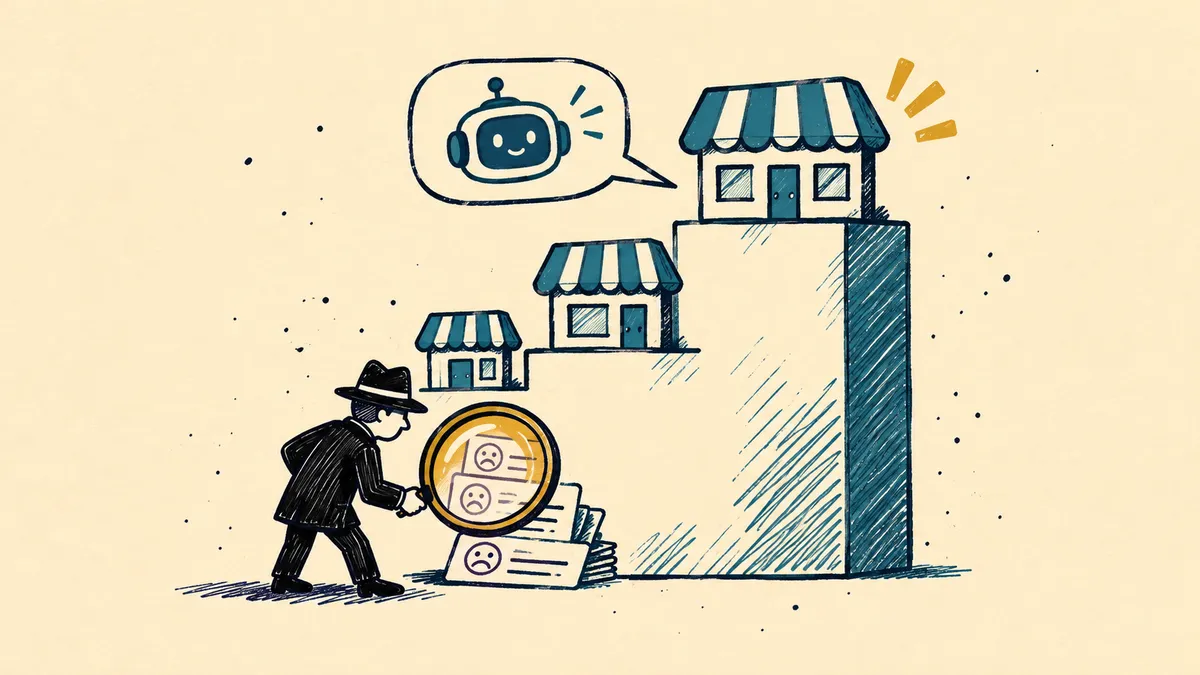
A good rating is not enough, because a brand's position in a recommendation depends on whether it appears in the rankings the model cites, and where. In one of the analysed cases, the studied brand and its competitor had almost identical mention frequency: 71% versus 72% of answers. Yet the competitor was named as the first choice more than twice as often: in 44% of answers versus 20%.
The reason lay in the sources. In 11 of the 14 rankings cited by AI, the competitor held a higher position. So the model did not rate the brands on its own. It repeated the order from other people's lists. A list of such rankings becomes a ready-made target list for digital PR.
Does a high rating guarantee a presence in answers?
No, rating and presence in answers are two separate measures. Presence was counted in answers to questions without the brand name, e.g. “Where can I buy a laptop?”.
| Brand | Rating | Presence in answers [%] | First recommendation [%] |
|---|---|---|---|
| Craft workshop | +2.83 | 6 | 3 |
| Craft workshop's competitor | +2.87 | 46 | 15 |
| Service | +0.78 | 39 | 19 |
| Highest-rated competitor of the service | +1.20 | 15 | 4 |
The craft workshop and its competitor had almost identical ratings, but the competitor was present almost 8 times more often. For the service, it was the other way round: the lower-rated brand appeared more often and was more often recommended first.
Why does AI most often recommend the biggest players?
For questions without a brand name, AI most often points to market leaders. The table shows their share of first recommendations in the studied brands' industries.
| Industry of the studied brand | Giants' share of first recommendations [%] | Recommended brands |
|---|---|---|
| Fashion store | 57 | Zalando, eobuwie, Answear |
| Small store | 52 | IKEA |
| DIY store | 44 | Castorama |
| Large store | 33 | Media Expert, MediaMarkt, Amazon |
| Service | 30 | Booking, Airbnb |
For the service, AI recommended intermediaries instead of the operator itself. A lack of presence turned out to be a more common problem than a weak rating. The study covered 90 purchase decision areas across eight brands. An area counted as “known” when AI mentioned the brand in at least 25% of answers that did not include its name. In 28 areas, AI did not know the brand, even though in 9 of them it rated the brand better than the competition.
One page per domain in an answer
AI rarely cites many URLs from one domain in the same answer. In the analysed answers, the model cited only one URL from a given domain 62.3% of the time.
| Number of cited URLs from one domain | Share of AI analyses [%] |
|---|---|
| 1 URL | 62.3 |
| 2 URLs | 14.2 |
| 3-5 URLs | 11.3 |
| 6-10 URLs | 5.2 |
| 11-50 URLs | 5.2 |
| 51-100 URLs | 0.8 |
| more than 100 URLs | 1.0 |
The takeaway is practical: more subpages on your own domain do not proportionally increase your presence in an answer. A presence on many different domains that the model draws on does more.
How does AI assess a brand's price and quality?
AI assesses a brand's price and quality the way the cited sources describe them, rather than the way the brand describes itself. In another analysed case, the sentiment of price mentions was +0.31, while for competitors it was +1.94. As many as 32% of price mentions had a negative tone. At the same time, quality and durability (+3.25) and installation (+3.36) were rated highest in the industry.
The problem was a missing value argument. Only 14.5% of statements about price included the justification that a higher price matches higher quality. Instead of fighting for a better rating of the price itself, the brand should explain its value: durability, warranty terms and the cost over the whole period of use. These arguments have to appear where AI gets its knowledge about the industry. In this case, that meant construction portals (28% of citations) and online forums (9% of citations).
Does every AI system rate a brand the same way?
No, the same brand gets different ratings in different AI systems. For the craft workshop, the gap between the lowest and highest rating was 1.45 points on a scale from -5 to +5. The highest-rating system was often Google AI Overview.
| Studied brand | System with the lowest rating | Lowest rating | System with the highest rating | Highest rating |
|---|---|---|---|---|
| Craft workshop | Perplexity | +1.89 | AI Overview | +3.34 |
| Manufacturer | ChatGPT | +1.93 | AI Overview | +3.07 |
| Small store | ChatGPT | +0.32 | AI Overview | +1.43 |
| B2B platform | Perplexity | +0.95 | Gemini | +1.94 |
| Service | ChatGPT | +0.17 | Gemini | +1.07 |
| Large store | Copilot | +0.79 | AI Overview | +1.67 |
| DIY store | Perplexity | +0.92 | Gemini | +1.56 |
| Fashion store | ChatGPT | +0.97 | Copilot | +1.75 |
A rating only makes sense in comparison with competitors. The craft workshop, rated +2.83, came third of four brands, because its competitors had +2.94, +2.87 and +2.07. The small store, rated +0.86, came second, with competitors rated +1.87, +0.62 and +0.52. For the large store, AI rated the price and the website clearly worse than for its competitors.
Which AI system brings traffic and revenue?
AI traffic was spread very unevenly. In the fashion store, ChatGPT delivered 95.9% of AI sessions in GA4 over 12 months. It also accounted for 98% of AI revenue, even though it rated this brand the lowest of all systems. Copilot rated it the highest but delivered only 0.3% of sessions. Gemini had 2.8% and Perplexity 0.9% of sessions.
Measurable AI traffic made up 1.7% of organic traffic in this store. Traffic from Google AI Mode and AI Overview cannot be separated out in GA4. That is why part of AI's impact on sales remains invisible in the reports. Whether GA4 in your store records traffic and traffic sources correctly can be checked with a free GA4 audit.
Can a brand's rating change without any action on its part?
Yes, the rating changes even when the brand changes nothing. A large store was asked the same 89 questions on 23.06, 17.08 and 18.09.2026. During a model change, its rating in ChatGPT rose by more than a point. In Gemini, with the same model, the score stayed stable: +1.64, +1.62 and +1.65. A single measurement is therefore not enough to assess a brand's image in AI.
How do negative posts affect what AI says about a brand?
Negative posts in cited sources make their way into AI answers, because the model synthesises what it found rather than what the brand would like to show. In the case described above, 32% of price mentions had a negative tone. As a result, AI presented the brand as expensive, despite the industry's highest ratings for quality and installation. Negative reviews do not have to be numerous to dominate an answer. It is enough that there is no content to balance them.
Where do negative reviews cluster?
Negative mentions are concentrated on a few sites. For all 8 studied brands, 5 domains produced between 1/3 and over half of the negative mentions. For the fashion store, 38% of answers citing Opineo rated the brand negatively. For GoWork it was 36%, for eKomi 31%, for Ceneo 27% and for Trustpilot 18%. Work on negative mentions is therefore best started on these few domains.
Do employee reviews affect a brand's image in AI?
Yes, AI can read employee reviews the same way as customer reviews. For the fashion store, GoWork, an employee review site, was the second source of negative mentions. For the apartment operator, an employer review site had 3.5k citations and the brand's own website 3.3k. Based on Trustpilot, AI wrote that “the brand is sometimes rated poorly”. The recommendation was to bring HR and employer branding into the work on the brand's image in AI. This includes an up-to-date employer profile and replies to employee reviews.
Why can one negative thread carry so much weight?
In the analysed answers, AI cited only one URL from a given domain in 62.3% of cases. If that URL is a critical forum thread, it may represent the entire forum in the answer. In the same case, forums made up 9% of citations and industry portals 28%. That is exactly where the brand should be present with substantive answers.
How should you respond to negative posts?
How to respond depends on the type of negative information. A genuine problem requires a change in the company: in the offer, the service or a process. Outdated or incorrect information requires contacting the sources about an update. Publishing current information on your own website and across the web also helps. Negative posts usually cannot be removed, but you can change the context in which AI reads them:
- replying to reviews on review sites and employer review sites, factually and without promotion;
- an open, expert presence in forum threads where complaints come up;
- publishing value arguments, e.g. about durability and warranty, in places AI cites;
- encouraging satisfied customers to leave reviews so that new posts balance the old ones.
In the case described, only 14.5% of statements about price included the argument that the price matches the quality. Increasing that share in cited sources is a more achievable goal than removing criticism.
Do posts from years ago still affect AI answers?
Yes, AI also cites content that is several years old, although it usually picks newer content than classic search results do. Ahrefs (July 2025) analysed around 17 million citations from ChatGPT, Perplexity, Gemini, Copilot and Google AI Overviews. The average page cited by AI was 1,064 days old, almost three years. In Google's organic results, it was 1,432 days.
| AI assistant (Seer Interactive, 2025) | Citations from 2023-2025 [%] | Citations from 2022 and earlier [%] |
|---|---|---|
| Google AI Overviews | approx. 85 | approx. 15 |
| Perplexity | approx. 80 | approx. 20 |
| ChatGPT | 71 | 29 |
Seer Interactive (June 2025) studied over 5,000 cited URLs with a publication date. ChatGPT reached furthest back, and the oldest content it cited dated from 2004. The takeaway is simple: a company blog post from several years ago can still be a source of AI's knowledge about the brand.
Szymon Parzych's study shows this with concrete examples. In September 2026, Perplexity cited a blog post from 12.06.2013 in 22 answers. It concerned an apartment investment offer, and the answers discussed the brand's credibility and prices. In August 2026, Perplexity assessed the credibility of an electronics store based on a 2019 ranking of popular online stores. ChatGPT, in turn, described the craft workshop partly based on a blog review.
What should you do with old content on your own blog?
Old posts with outdated prices, discontinued products or a former offer can lock an outdated image of the brand into AI answers. Ahrefs also shows that AI assistants are more willing to cite fresher content. So it is worth reviewing the blog archive regularly:
- update posts with outdated data and mark the update date;
- merge or redirect posts about discontinued products to their current equivalents;
- remove contradictions between old posts and the current offer.
The model's own knowledge, without web search, depends on the cutoff date of its training data. OpenAI states that this date differs for each model. That is why current content on the web matters most when the assistant uses search.
How do you check which sources AI uses to learn about your industry?
You check AI's sources of knowledge about an industry by collecting the domains cited in answers to customers' purchase questions. You do not have to be everywhere. It is enough to find out which domains AI cites most often and start with them. The mapping process has four steps:
- Collecting a list of AI knowledge sources for specific customer purchase questions.
- Ranking domains in descending order by the number of answers they appear in.
- Highlighting domains that mention many competitors, especially those where your brand is missing.
- Determining the type of each of the most important domains, because it determines the kind of action.
How to measure a brand's presence in ChatGPT and Google AI Overview answers is covered in our article on brand visibility in AI.
What should you do on each type of site?
The type of cited site determines which actions make sense. Building a presence in an industry portal's ranking works differently from building one on a review site.
| Site category | Example platforms | Recommended actions |
|---|---|---|
| Industry portals and blogs | Expert sites, topical blogs | Expert articles, presence in rankings, reviews and tests |
| Media and publishers | General and business portals | Data and comments ready to quote, press releases |
| Review sites | Trustpilot, Opineo, Ceneo, G2 | Collecting reviews and replying to them |
| Employer reviews | GoWork, Aplikuj, careers tabs | Replies to employee reviews |
| Forums and communities | Industry forums, Reddit, Wykop | An open expert presence without pushy promotion |
| Social media and video | Facebook, LinkedIn, YouTube | Posts on the profile and in groups, video content |
| Marketplaces and intermediaries | Booking, Allegro, Amazon | Complete and consistent listings |
| Business directories | Oferteo, PHD, Aleo | Completed listings with consistent data |
Customer reviews and forum posts are user-generated content, or UGC. A brand does not control them directly, but it can encourage customers to leave reviews and reply to them. Consistent name, address and description across all sources also makes it easier for the model to recognise that they refer to the same company. On your own website, Schema.org structured data helps with this.
We grow a brand's visibility in search and in language model answers as part of our SEO service.
Frequently asked questions
Q.Does AI have its own opinion about brands?
No, AI has no opinion of its own about brands. It generates an answer as a synthesis of what it found in external sources on the web. If industry rankings place a competitor higher, the model will usually repeat that order. That is why what others write about a brand has the most influence on AI's answer.
Q.Is your own website enough for AI to recommend your brand?
No, your own website lets the model describe the brand, but rarely makes it the first choice. In Szymon Parzych's study, the brand's website appeared in 51-73% of answers. Recommendations, however, were decided by rankings on other domains. The competitor that ranked higher in 11 of 14 rankings was named the leader more than twice as often.
Q.Where should you start building a brand's visibility in AI?
Ideally with a map of the domains AI cites for purchase questions in your industry. The domains are ranked by the number of answers they appear in. Start with the ones that mention competitors and leave your brand out. The type of domain determines the action, e.g. digital PR, reviews or business listings.
Q.Do AI Overviews require special optimisation?
No, Google states that there are no additional requirements or special optimisation for AI Overviews and AI Mode. A page has to be indexed and eligible to be shown with a snippet. No special AI files or additional markup are needed. What matters is whether the page answers the questions customers ask.
Sources
- Google Search Central, “AI features and your website”
- OpenAI Help Center, “ChatGPT search”
- OpenAI Help Center, “Do the OpenAI API models have knowledge of current events?”
- Ahrefs, Ryan Law, “New Study: AI Assistants Prefer to Cite ‘Fresher’ Content (17 Million Citations Analyzed)”, 28.07.2025
- Seer Interactive, Sonny Vasquez, “Study: AI Brand Visibility and Content Recency”, 25.06.2025
- Search Engine Land, Danny Goodwin, “Google AI cites social media 52% more, ChatGPT 44% less: Study”, 23.11.2026
- Semrush, “AI citations to social media & UGC grew 52% on Google's AI platforms, fell 44% on ChatGPT”, 2026
More on SEO and AI search
- Agentic Commerce Funnel: how the sales funnel is changing in the era of autonomous AI agents
- 12 internal linking patterns that change SEO more than one more link in the text
- ChatGPT Business Hub insights: mentions, website clicks and discovery topics
- AI in e-commerce: how an online store can benefit from artificial intelligence and AI recommendations
- Google AI Overviews in practice: the mechanism, decision gates and an action plan
- New Google materials for SEO: search traffic, CDN and “things to do”
- How to increase your brand's visibility in ChatGPT and Google AI Overview
- Google Lighthouse update changes how PageSpeed Insights simulates loading
- AI Search: how AI-powered search works
- AI hallucinations: causes and safeguards
- Duplicate content and AI citations: what Google patents say
- How Much Does SEO Cost: Pricing Guide and Red Flags to Watch For
- ChatGPT Ads: how the channel works and how to run a first test worth learning from
- GEO: Will Your Brand Disappear From Results If You Don't Optimize for AI?

When checking a brand's visibility in AI, Paweł collects the domains cited for customers' purchase questions. He starts with the ones that mention competitors and leave the brand out.
LinkedInRelated articles
Let's talk growth
Send a brief or drop your contact. We'll reply within 24h.
Get a quote